Seed Bead Animal Patterns: Six Little Animals You Can Bead Tonight
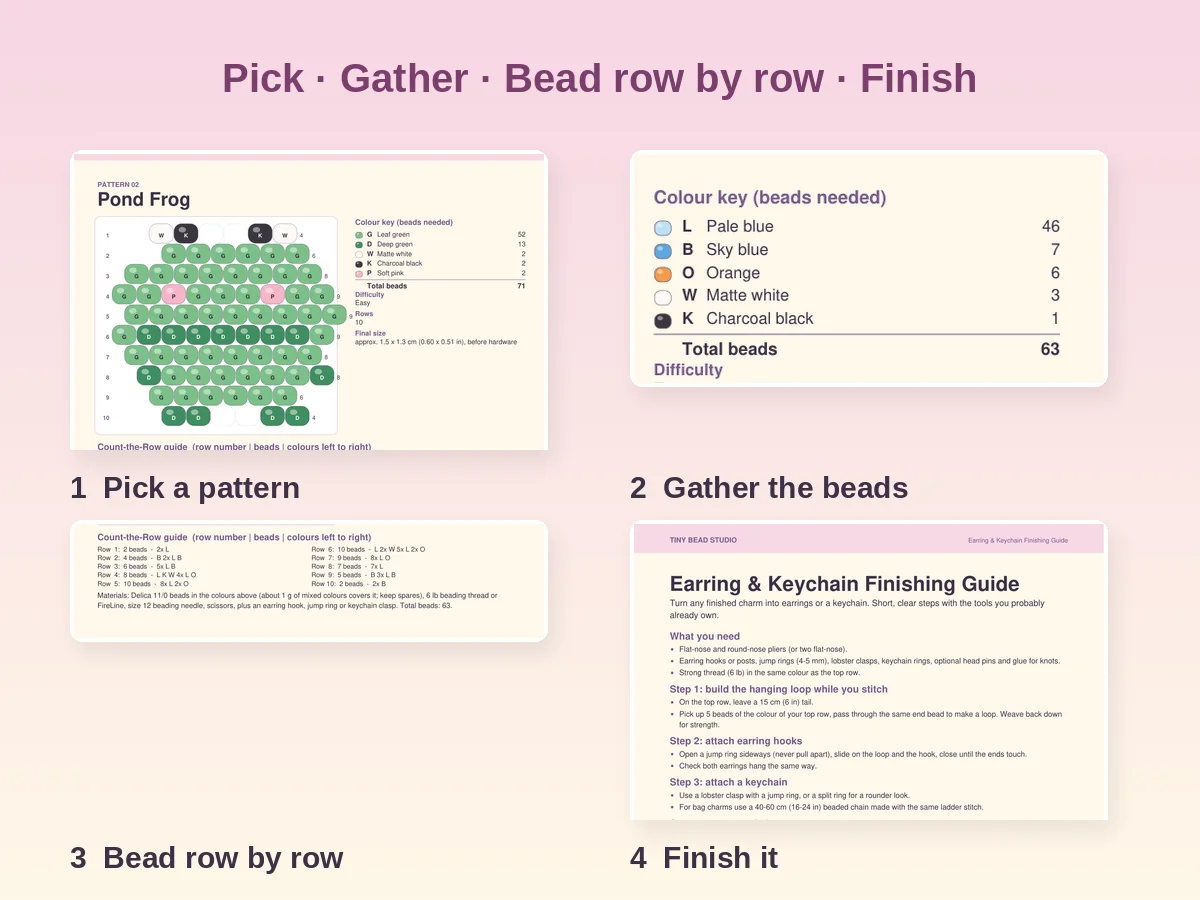
Seed bead animals are tiny flat figures, usually 60 to 90 beads, built in brick stitch row by row so that a fish, a frog or a duck appears out of a pile of coloured dots. They are one of the nicest ways to learn beading, because they give the stitch a purpose: you are not practising, you are making a frog.
Here are six animals from Tiny Bead Studio · Beaded Charm Starter Pack, what each one teaches, and the little tricks that make a chart-drawn animal look alive.
How an animal appears from rows
A flat animal is a silhouette. The width of each row defines the outline: a fish grows from 2 beads to 10 and back to 2, a duck climbs to 9 beads wide and stays tall. Colours inside the outline carry the details: the eye is one dark bead, a cheek is one pink bead, a beak is a pair of orange beads at the edge.
You can see this in the numbers. The Little Fish's rows run 2, 4, 6, 8, 10, 10, 9, 7, 5, 2, a perfect little ellipse with the orange tail added at the end of rows 4 to 7. Once you read a chart this way, you stop being afraid of it.
The six animals
Little Fish: 10 rows, 63 beads
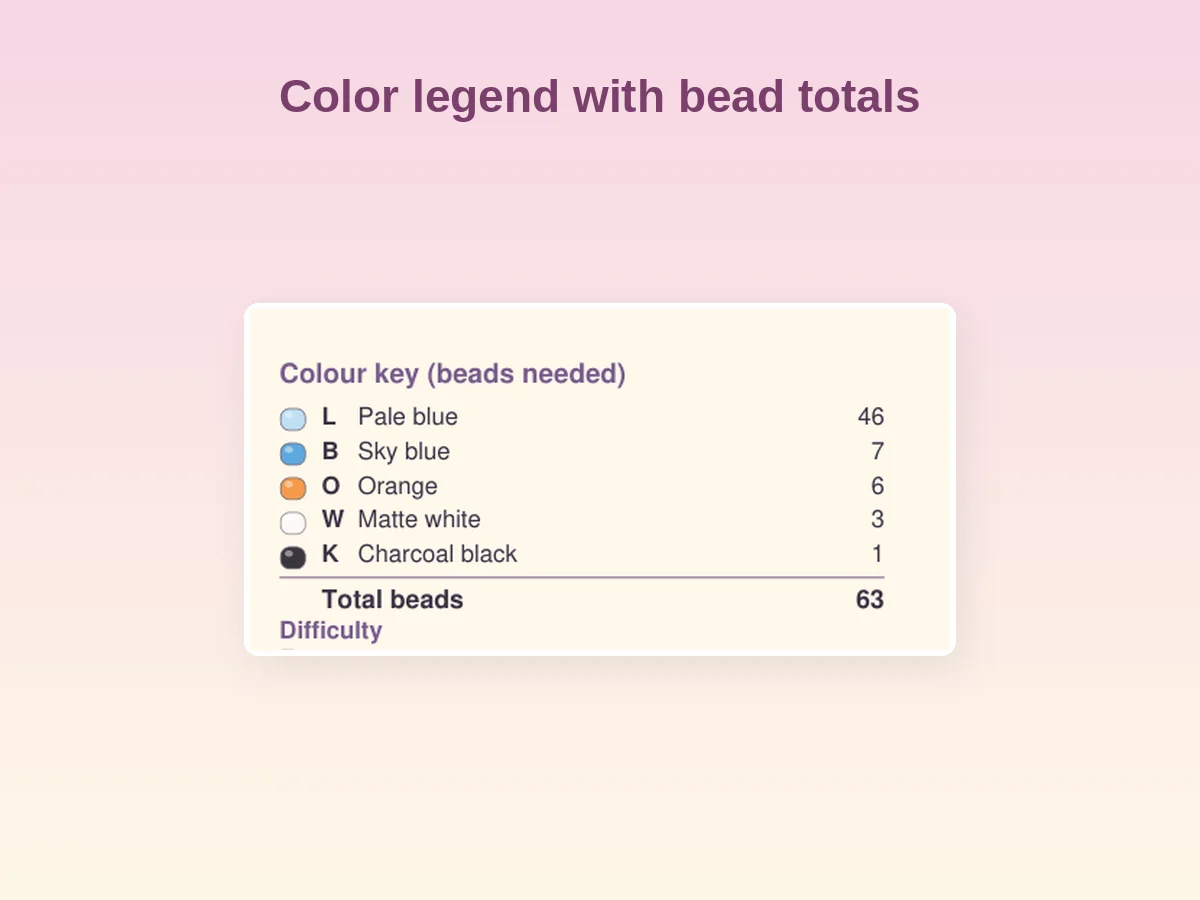
Pale blue body, sky blue edges, a few white highlight beads and one charcoal eye. It teaches the full routine: ladder-stitch base, plain rows, increases at the top and decreases at the bottom. About 1.7 x 1.3 cm before hardware.
Pond Frog: 10 rows, 71 beads
Leaf green and deep green, soft pink cheeks, white eyes with black pupils, and a gap in the final row that separates two legs. The eyes sit in row 1, which means you place the most delicate detail first, when the piece is still easy to hold.
Rubber Duck: 14 rows, 85 beads
The tallest of the set. Sunny yellow with an orange beak and a white highlight. The duck teaches you how to repeat a plain wide row without getting bored: the middle rows are wide and nearly the same, and the count guide keeps you honest.
Bumblebee: 12 rows, 68 beads
White wings, yellow and black stripes. Only three colours, which makes the bee the best choice if you are buying beads for the first time. Stripes also teach colour changes without the pressure of an image.
Octopus: 10 rows, 72 beads
Lavender with pink cheeks and white-and-black eyes. The legs are alternate gaps in the last two rows: a shape trick that looks complicated and is not. In row 9 the chart reads V . V . V . V . V, and that is the whole secret.
Sweet Ghost: 11 rows, 86 beads
White body, black eyes, pink cheeks, pale blue feet. It is the largest piece by bead count, with a wavy hem. The reward is a charm that looks good on a dark jacket.
Little tricks that make animals look alive
- Place the eye away from the centre. In the fish the eye is in row 4, the second bead from the left, which gives a direction to the animal.
- Use a single contrast bead. A pink bead for a cheek on the frog and ghost lifts the whole face.
- Keep spare beads of every colour. Seed beads vary in size; if one looks fat, swap it for another from the dish.
- Pull the thread snug, not tight. Tight work puckers; loose work shows thread between beads.
- Check every row. The Count-the-Row guide lists the number of beads in each row. Stop and compare before you move on.
The Start Here routine
The guide in the pack lists six steps for your first charm:
- Pick Pattern 01 (Little Fish) or any Beginner pattern. Check the colour key and pour a few beads of each colour into a small dish.
- Cut about 1 m (40 in) of thread, thread the needle and leave a 10 cm (4 in) tail.
- Make the ladder-stitch base from row 1.
- Work each next row in brick stitch, adding the number of beads for that row.
- Compare the row with the Count-the-Row guide as you go. If the count is off, fix it before the next row.
- Weave in the thread and add hardware.
Materials
Delica 11/0 beads in the colours listed, 6 lb beading thread or FireLine, a size 12 beading needle, scissors, and an earring hook, jump ring or keychain clasp. A matt bead tray or a felt square keeps the beads from rolling, which is the number one cause of lost beads.
Ideas for sets
- A pond set: fish, frog and duck for a bag zipper.
- A garden pair: bee and a tulip, one on each earring.
- A night set: ghost and octopus in a spooky palette.
Use the colour planning sheet in the pack to try alternatives: a golden frog, a pink octopus, a mint ghost. Fill the grid before you open the beads, and read off the totals.
Common questions before you start
People ask whether they need to know peyote or loom work first. You do not: the guide teaches ladder stitch and brick stitch from zero. They also ask whether the animals are too small to bead by eye. They are small, but the chart is large and clear on the page, and you only ever look at one row at a time. If your eyes tire, work near a window and use a light-coloured tray under dark beads, such as the charcoal ones, so they stay visible.
Who these patterns are for
If you have beaded before, they are a quick project that gives you something to gift. If you have not, they are a safe first step: small, clear and finishable. They are not for you if you want a three-dimensional peyote figure or a bracelet; these are flat charms.
What you finish with
A set of small animals, a tidy habit of counting rows, and a feeling that beading is not hard, it was only badly explained. The first animal takes an evening. After that you know the stitch, and every chart is just a new shape.