Beaded Keychain Patterns: Ten Charms That Survive Your Keys
A beaded keychain is a small flat charm of seed beads, worked in brick stitch and clipped to a ring, so your keys, zipper or bag get a bit of personality. It is a perfect first project: it finishes fast, it shows, and it is useful on the same day.
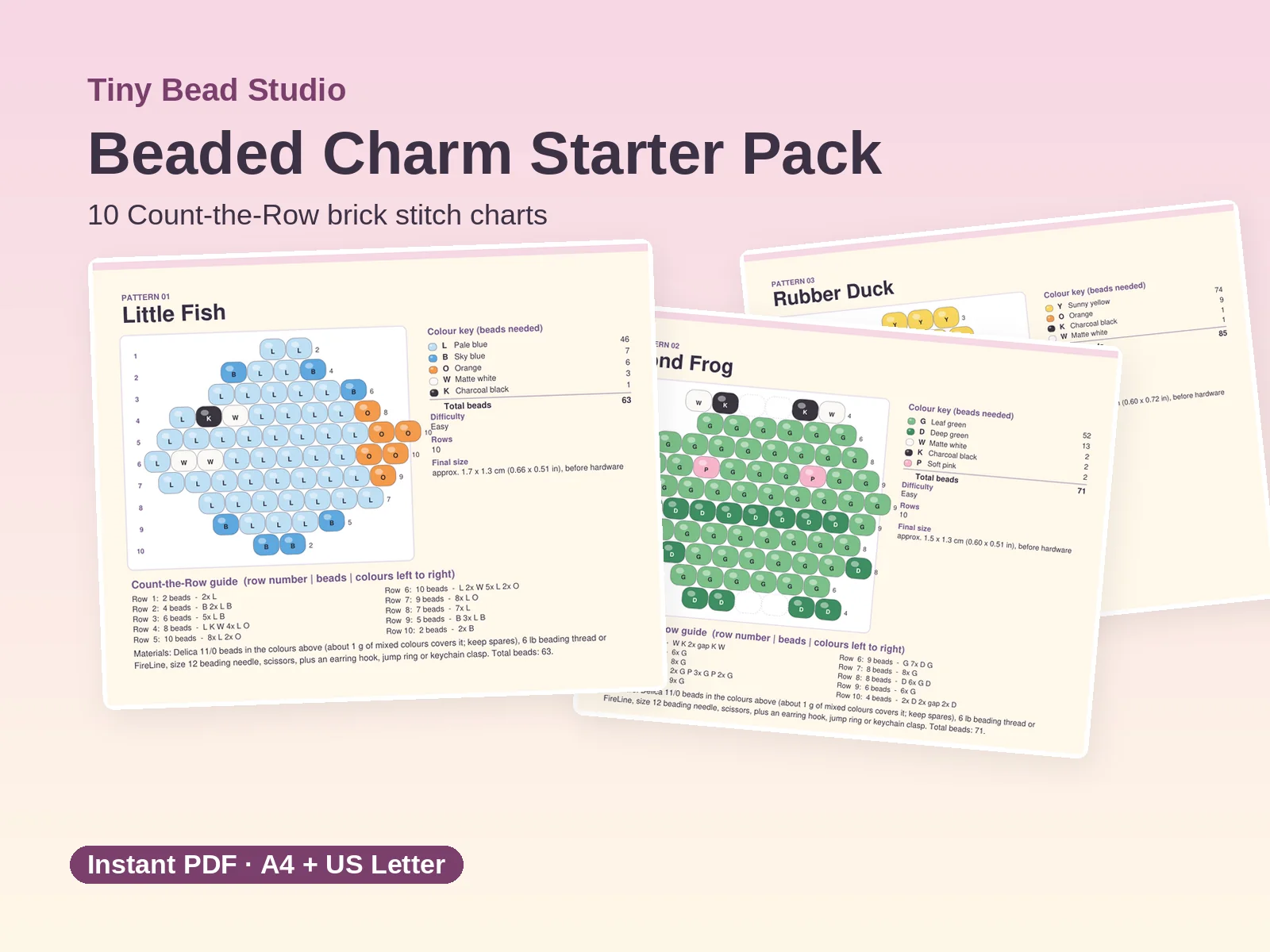
This guide covers what makes a charm survive a pocket, which patterns suit keys, and how to finish the piece. The charts come from Tiny Bead Studio · Beaded Charm Starter Pack.
What a keychain has to survive
Keys live in bags, pockets and the bottom of cars. A beaded charm on them needs three things:
- Strong thread. 6 lb beading thread such as FireLine, not sewing cotton. Beading thread does not stretch and does not fray on bead edges.
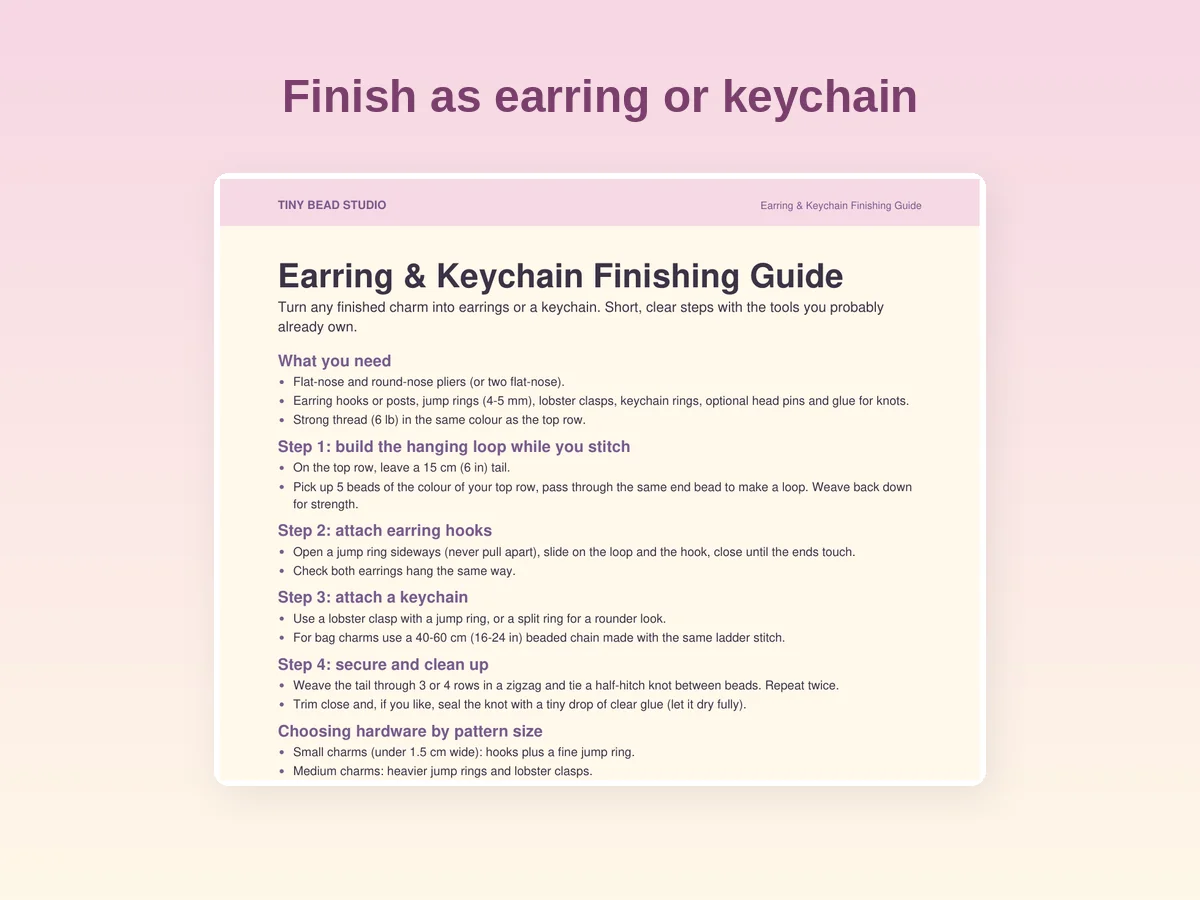
- A secure tail. Weave the end of the thread in a zigzag through 3 or 4 rows and tie a half-hitch knot between beads. Repeat twice and trim close.
- A sturdy loop and hardware. A loop made from beads at the top row, a jump ring and a lobster clasp or split ring.
If you do these three things, a flat brick stitch charm will outlive the keys.
Which charms make the best keychains
Flat, compact and recognisable at a glance. From the ten in the pack:
- Rubber Duck (85 beads, 14 rows). The tallest and most obviously a keychain.
- Little Fish (63 beads). Light and simple.
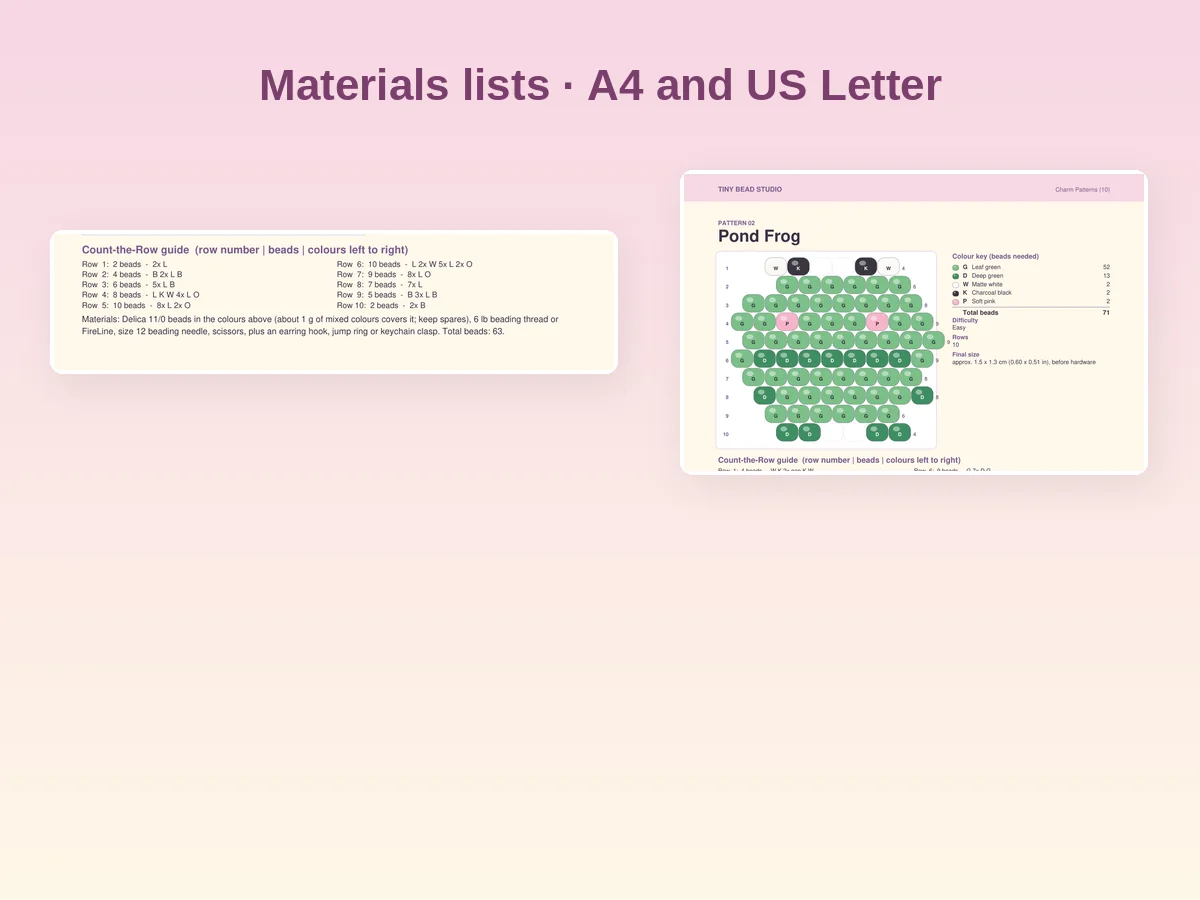
- Pond Frog (71 beads). The one people ask about.
- Rice Ball, Onigiri (80 beads). Lovely with a small ramen-lover's bag.
- Strawberry (80 beads). Bright red among silver keys.
Smaller charms such as the tulip (61 beads) work better as earrings, while the ghost (86 beads) is the one for a backpack zip.
Step by step: a Little Fish keychain
- Gather. Delica 11/0 beads: 46 pale blue, 7 sky blue, 6 orange, 3 matte white, 1 charcoal. About 1 g of mixed colours with spares. Thread, size 12 needle, scissors.
- Make the base. Cut about 1 m of thread, leave a 10 cm tail, and make a 2-bead ladder-stitch base from row 1.
- Bead the rows. Follow the Count-the-Row guide: 2, 4, 6, 8, 10, 10, 9, 7, 5, 2.
- Build the loop while you stitch. On the top row leave a longer tail (15 cm), pick up 5 beads in the colour of your top row, pass through the same end bead to make a loop, and weave back down for strength.
- Add hardware. Open a jump ring sideways, slide on the loop and a lobster clasp, close until the ends touch.
- Secure. Weave the tail, knot, trim. A tiny drop of clear glue on the knot is optional; let it dry fully.
The finishing steps above are covered in basic form on the finishing page of the Start Here guide; a longer Earring & Keychain Finishing Guide with hardware choices by size is sold separately.
Choosing hardware by size
- Under 1.5 cm wide: earring hook and a fine jump ring.
- Medium charms: heavier jump rings and lobster clasps.
- Bag charms: a 40 to 60 cm beaded chain worked with the same ladder stitch, so the strap matches.
Match the metal to your keys: silver, gold or black. A black clasp makes a white ghost look more graphic.
Colour ideas for keychains
Keys are metal, so charms with a clear colour block stand out. A yellow duck against silver, a red strawberry, a green frog. For gifts, pick a palette that matches the person: a charcoal and orange fish for someone who loves dark jackets.
The pack has a colour planning sheet with blank grids so you can test a palette before ordering beads. Swapping the fish into lavender takes five minutes with coloured pencils.
A set for a household
One of the best things about a keychain pattern is that it makes a set cheaply. Three keychains for three people take roughly three evenings, and the second is always faster. Each person gets a different animal; the thread and clasps are the same.
Common problems and fixes
- The charm curls. The thread is too tight. Relax your tension and the rows lie flat.
- Gaps between beads. The thread is too loose or the bead sizes are mixed. Take up the slack on the next pass.
- A bead cracked or chipped. Replace it with a spare. Always keep spares of each colour.
- The clasp twists. Use a split ring instead of a jump ring.
What you do not need
A loom, a workshop or a pile of tools. Two pliers help, but a pair of flat-nose is enough. Everything else is a needle, thread and beads.
How to carry the colour story across a whole bag
Once you have one keychain, the next question is how the charm sits with what you carry. A set of keys in silver pairs well with the cooler colours of the pack: the pale blues of the fish, the lavender octopus, the white ghost. Brass or gold keys sit better with the warm charms: the yellow duck and bee, the tulip's reds, the cream fried egg. If your bag is a neutral canvas, a single bright strawberry or frog becomes the focal point. Two or three charms of different sizes on one clasp looks intentional, as long as you keep the palette to two or three colours. The colour planning sheet exists exactly for this: colour three grids with pencils, lay them side by side and see which set you would pick up first.
How long they last
Flat brick stitch is among the most durable beadwork because every bead is held by thread passing through its neighbours several times. The weak points are always the hardware and the tail. Check the jump ring is fully closed, and look at the knot after the first week of use. If the charm lives on a keyring that gets thrown in a bag every day, a drop of clear glue on the knot and a split ring instead of a jump ring are the two upgrades worth making.
What you have at the end
Ten patterns, one evening and a keychain that nobody else has. If it is a gift, the person sees the frog and then sees that you made it. If it is for you, it is the first thing your hand finds when you reach for your keys.
You may sell the physical pieces you bead by hand. The PDF files are for personal use and cannot be shared or resold.