Beading Patterns for Beginners: Start With a Charm You Can Finish
The best beading patterns for beginners are small, flat and counted: a charm of 60 to 90 beads, with the number and colour of beads written beside every row. Big, impressive designs are the reason most beginners abandon a bead mat after one night; a tiny frog you can finish before bedtime is the reason they come back.
This guide explains what beginners need from a pattern, which charm to choose, and walks through a first project using the Start Here guide from Tiny Bead Studio · Beaded Charm Starter Pack.
Why the first project goes wrong
You find a beautiful picture of a beaded animal. You buy beads. You begin, and halfway through row four you discover you have no idea whether you have the right number of beads, or where the next colour goes. The shape drifts. You stop.
The problem is not your hands or your patience. It is a pattern that does not tell you what goes where, row by row. Common traps:
- Losing count mid-row. One bead too many and the animal leans.
- Guessing colours. You are halfway and find you bought the wrong shade, or not enough.
- A picture and no chart. A cute photo does not tell you how many beads go in each row.
- No clear finish. The beading is done and nobody shows you how to attach a clasp.
A good beginner pattern solves each one, and that is the idea behind the Count-the-Row charts.
What a beginner chart looks like
Take the Little Fish, Pattern 01. It has:
- A drawing of every bead, in staggered rounded shapes.
- A colour key: pale blue 46, sky blue 7, orange 6, white 3, charcoal 1. Total 63.
- A difficulty label: Easy.
- A row guide: row 1 has 2 beads, row 2 has 4, row 3 has 6, and so on to row 10 with 2.
- A materials line with the beads, thread and needle.
You never ask yourself what to do next. You read the next line.
Which charm to bead first
Start small and symmetrical:
- Little Fish (63 beads, 10 rows). Five colours, with the techniques the guide teaches.
- Bumblebee (68 beads, 12 rows). Three colours and stripes, so colour work is easy.
- Tulip (61 beads, 12 rows). The smallest bead count.
- Rice Ball (80 beads, 11 rows). Three colours and a very clean shape.
Leave the Rubber Duck (85 beads, 14 rows) and the Sweet Ghost (86 beads) for the second week. They are not harder in technique, only longer.
The shopping list
- Delica 11/0 seed beads in the colours of the chart. About 1 g of mixed colours covers a small charm, and you should have spares.
- 6 lb beading thread such as FireLine.
- A size 12 beading needle.
- Small scissors.
- A small dish or tray, and a mat or felt square so beads do not roll.
- An earring hook, jump ring or keychain clasp.
That is it. No loom, no frame, no special workspace.
Your first charm in six steps
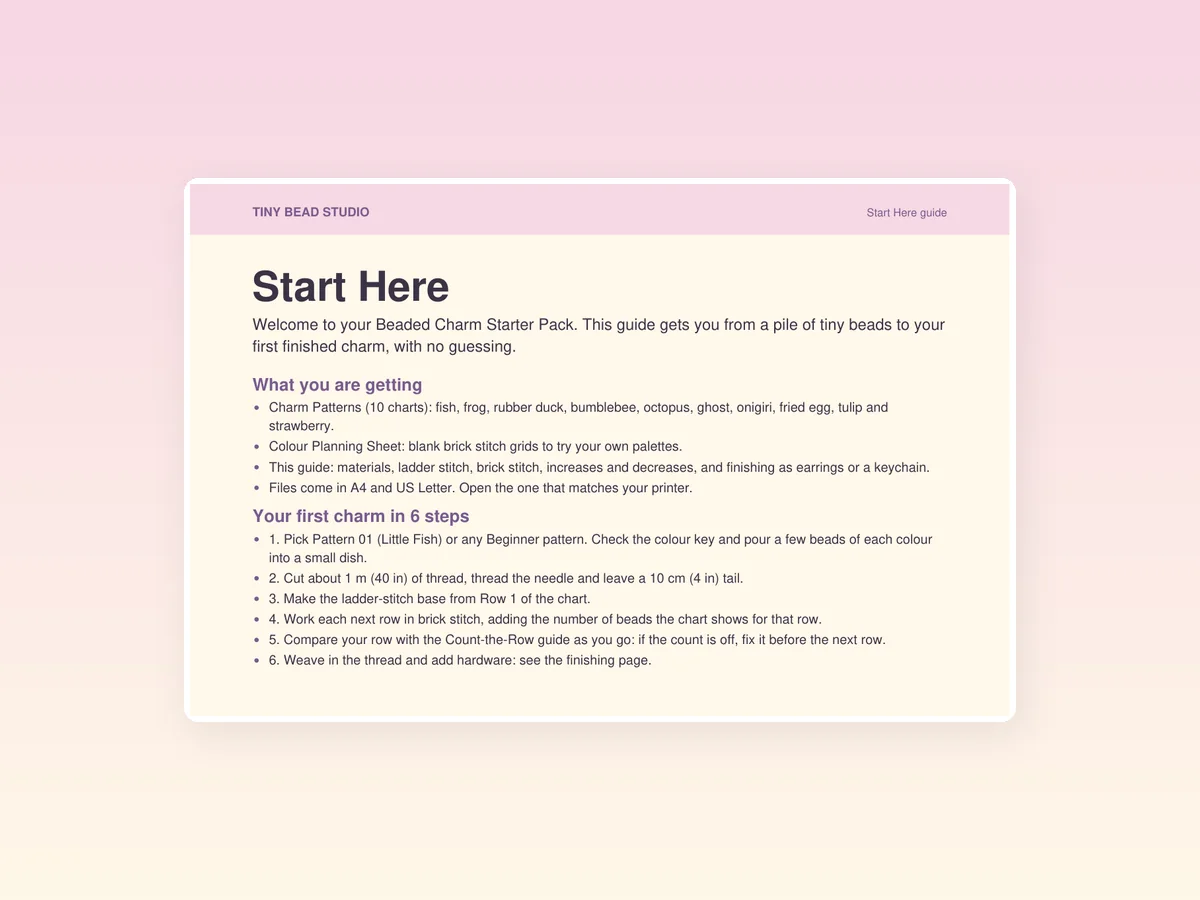
The Start Here guide gives the sequence:
- Pick Pattern 01 (Little Fish) or any Beginner pattern. Check the colour key and pour a few beads of each colour into a small dish.
- Cut about 1 m (40 in) of thread, thread the needle and leave a 10 cm (4 in) tail.
- Make the ladder-stitch base from row 1 of the chart.
- Work each next row in brick stitch, adding the number of beads the chart shows for that row.
- Compare your row with the Count-the-Row guide as you go. If the count is off, fix it before the next row.
- Weave in the thread and add hardware.
Ladder stitch, brick stitch, increases and decreases are explained in the guide, with the thread path drawn out, not described in words alone.
What the first hour feels like
The first row is the slowest, because you are learning where the needle goes. By row 3 your hands have the pattern: pick up beads, pass through, snug. By row 6 you are not thinking about the stitch at all. You are looking at the chart and ticking off numbers. By row 10 the fish is in your palm and you wonder why anyone said beading was hard.
Choosing your colours
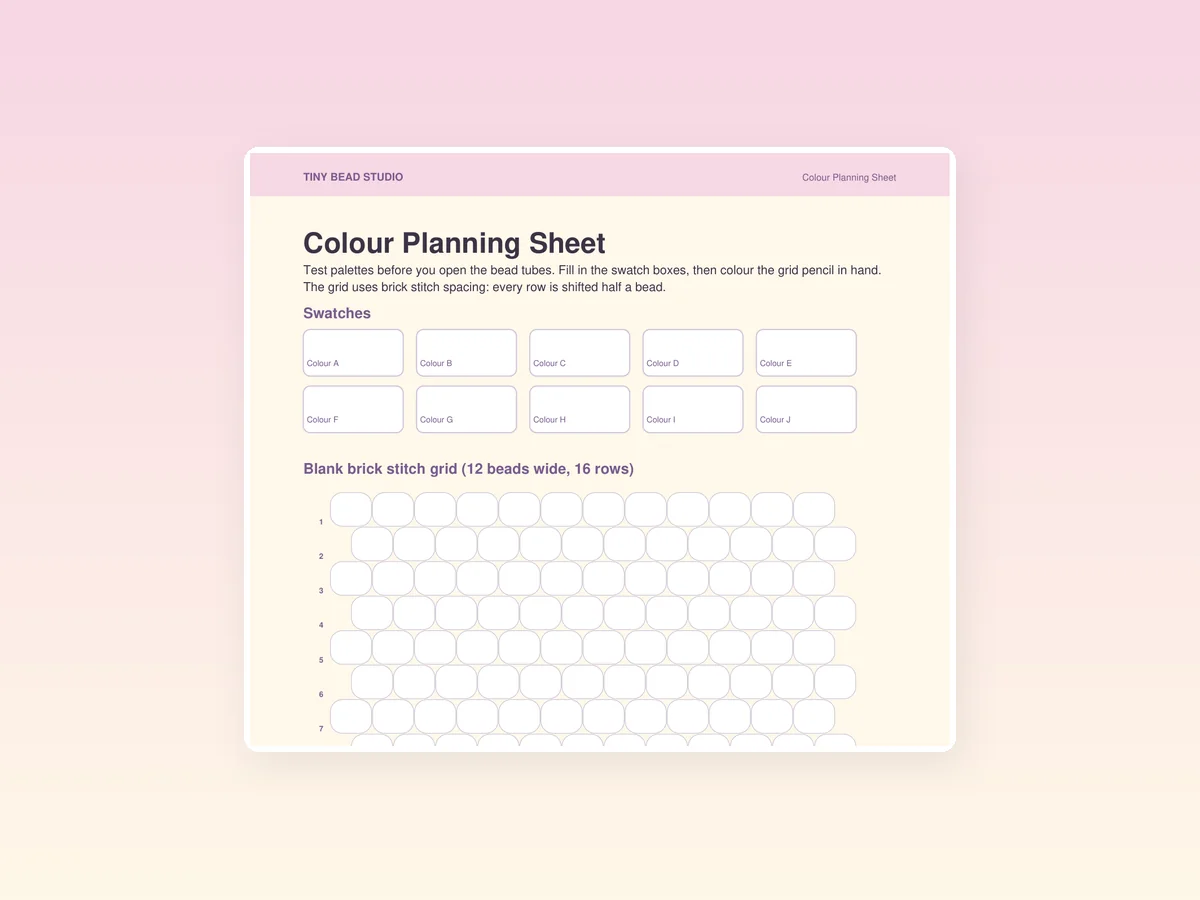
Beginners often worry about colour. The pack includes a colour planning sheet with blank brick stitch grids. Print one, colour it with pencils, and see how a pink fish or a lilac frog looks before you buy. The real chart colours are a good default, but your own palette makes a charm feel yours.
Troubleshooting for beginners
- Beads keep rolling. Use a mat or felt. A small dish with a rim helps.
- The thread tangles. Use shorter lengths; 1 m is a good limit.
- The piece curls or puckers. Your tension is too tight. Relax.
- A gap shows between rows. Pull the thread snug on the next pass.
- You lose your place. Tick off each row with a pencil, or use a sticky note under the row you are working on.
- A bead is the wrong colour. Unpick back to the row, using the needle to take the thread out, and reuse the beads.
From one charm to a habit
When the fish is done, you will want another. Pick the frog, then the bee. Each uses a slightly different combination of the same stitches. After four or five, you will not be reading the guide, only the chart. After ten, you may start drawing your own on the planning sheet.
What is in the pack
Ten charm charts, the Start Here guide, a colour planning sheet and A4 and US Letter files. A one-time payment and an instant download. The files are for personal use; you may sell physical pieces you bead by hand.
The result
An evening, a small pile of beads and a charm you made. For a beginner, that first finished piece is worth more than any amount of reading about it.