Brick Stitch Patterns: Printable Charts You Can Finish in an Evening
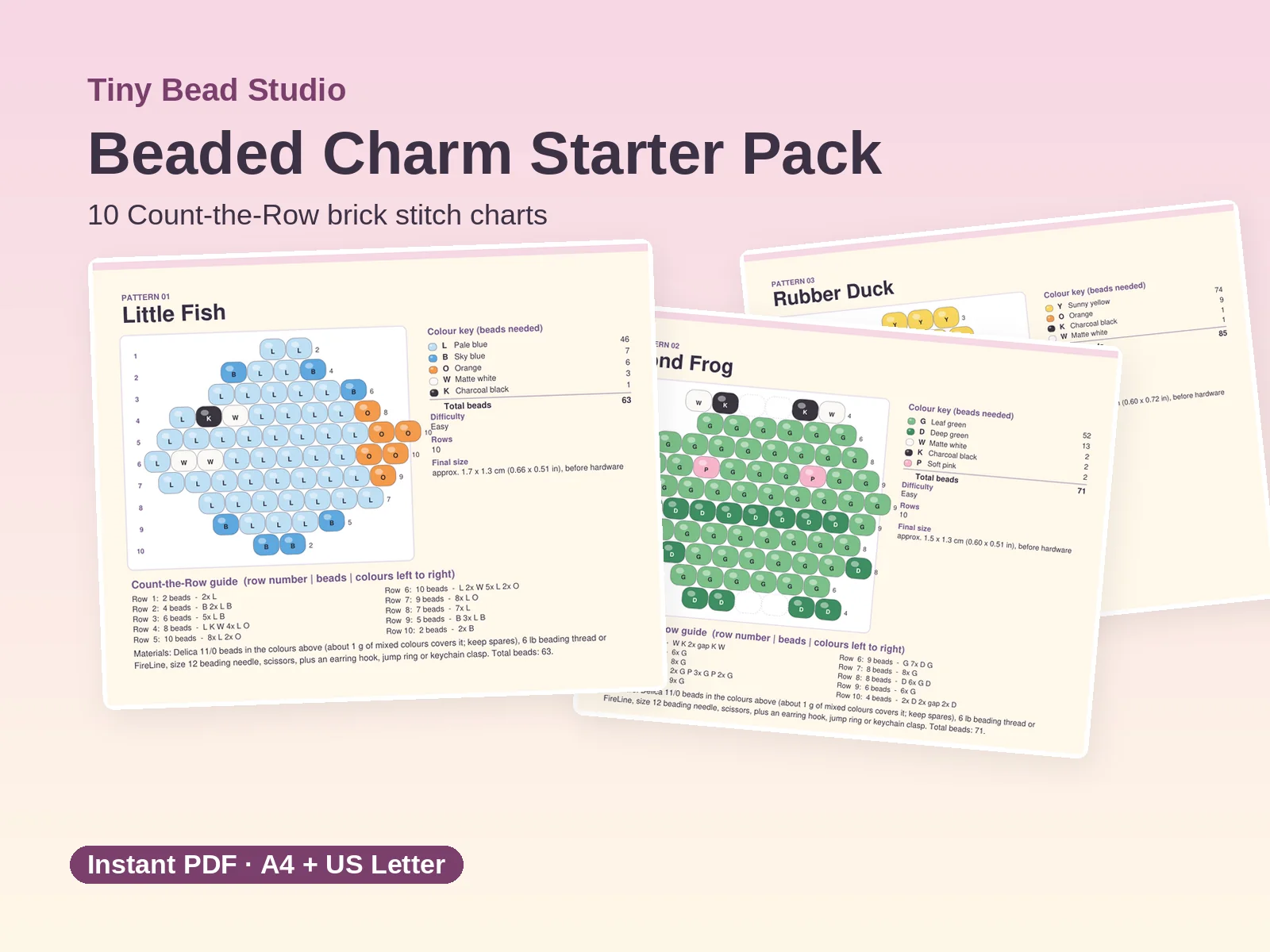
A brick stitch pattern is a chart that tells you which seed bead goes where, row by row, so a handful of tiny beads turns into a flat charm, earring or keychain. The stitch itself is simple. What makes or breaks your first piece is the chart: if it only shows a picture, you will lose count by row four; if it states the number of beads and the colours of every row, you can finish a little fish in one sitting.
This guide explains how brick stitch charts work, what to look for before you buy one, and what the 10 charts in Tiny Bead Studio · Beaded Charm Starter Pack actually contain.
What a brick stitch chart shows
In brick stitch each bead sits half a step above and between two beads of the row below, so the rows interlock like bricks. Because of that offset, a chart is drawn as staggered rounded rectangles, not a square grid. Every bead in the drawing is one bead in your hands.
A chart you can trust has four things:
- The drawing, with a letter or colour on every bead.
- A colour key that says how many beads of each colour you need.
- A row guide that lists the bead count of each row, so you can check as you go.
- A materials line: bead type, thread, needle and the hardware to finish.
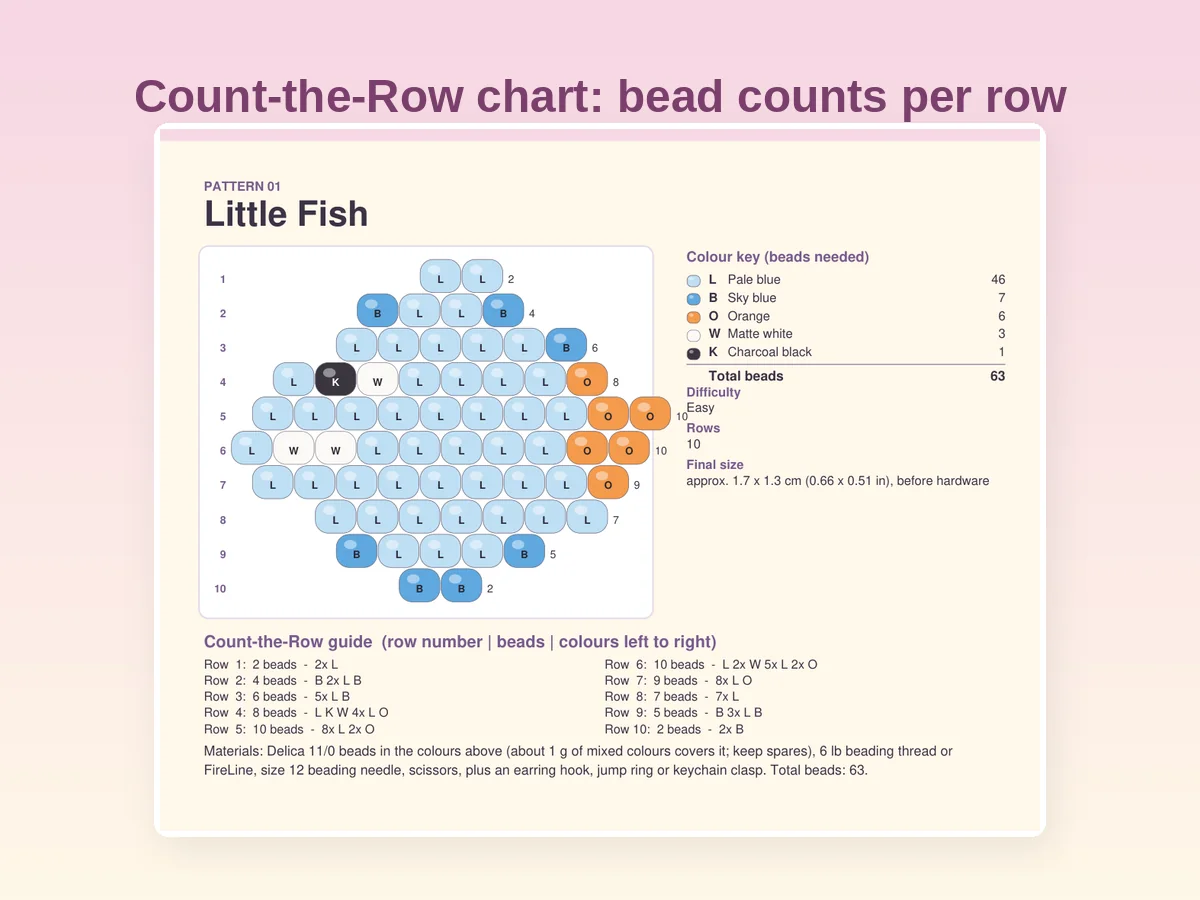
The charts in this pack carry all four. Take the Little Fish, Pattern 01. It has 10 rows and 63 beads in five colours: 46 pale blue, 7 sky blue, 6 orange, 3 matte white and 1 charcoal black for the eye. The Count-the-Row guide reads: row 1, 2 beads, 2 pale blue. Row 2, 4 beads, sky blue, 2 pale blue, sky blue. Row 5, 10 beads. Row 10, 2 beads. When your fifth row has 9 beads instead of 10, you know before you build row six on top of the mistake.
Why counting matters more than skill
Beginners often assume brick stitch is hard because the thread passes through the same beads several times. In practice, the thing that spoils a piece is a wrong count in the middle. One bead too many and the shape leans to one side; one missing and a gap opens along the edge. Count-the-Row charts remove that guesswork: every row is a small task with a number at the end.
This is also why it helps to start with flat pieces of 60 to 90 beads. They are big enough to look like an animal and small enough to finish before your attention drifts.
The 10 charts in the pack
All ten are flat brick stitch charms. Bead counts come straight from the charts:
| Pattern | Rows | Beads | Colours |
|---|---|---|---|
| Little Fish | 10 | 63 | 5 |
| Pond Frog | 10 | 71 | 5 |
| Rubber Duck | 14 | 85 | 4 |
| Bumblebee | 12 | 68 | 3 |
| Octopus | 10 | 72 | 4 |
| Sweet Ghost | 11 | 86 | 4 |
| Rice Ball (Onigiri) | 11 | 80 | 3 |
| Fried Egg | 11 | 76 | 3 |
| Tulip | 12 | 61 | 4 |
| Strawberry | 12 | 80 | 3 |
That is 742 beads across the ten charms, and the widest row on any chart is 10 beads. The pieces stay small: the Little Fish measures about 1.7 x 1.3 cm before hardware, which is right for an earring or a bag charm.
The bumblebee and the onigiri use only three colours, which makes them the calmest first projects if you are buying beads for the first time. The frog and the fish teach you to place a single dark bead for an eye, which is where the charm gets its face.
Start with one project, not ten
A sensible order for the first week:
- Day one: the Little Fish. Five colours, 63 beads, the full set of techniques: ladder-stitch base, plain rows, a few increases, and a short decrease at the tail.
- Day two: the Bumblebee. Three colours, stripes, a symmetric shape.
- Day three: the Strawberry, where the yellow seeds are scattered and you practise reading a colour pattern, not just a stripe.
- After that: pick the one you want to wear. The Tulip makes a pair of earrings that look more elaborate than they are.
The ladder-stitch start
Every chart begins with a ladder-stitch base, a row of beads joined side by side that acts as the foundation for the first row of bricks. The Start Here guide in the pack explains it with the thread path drawn out: cut about 1 m (40 in) of thread, thread the needle, leave a 10 cm (4 in) tail, build the base from row 1 of the chart, and then work each new row in brick stitch, adding exactly the number of beads the chart shows. Compare as you go, and fix any difference before the next row.
The same guide covers increases and decreases, which are the way a flat piece changes width. On the octopus, for example, the legs at the bottom are a repeating gap in the chart, and once you have seen it in the fish tail, it is not a surprise.
Planning colours before you open the beads
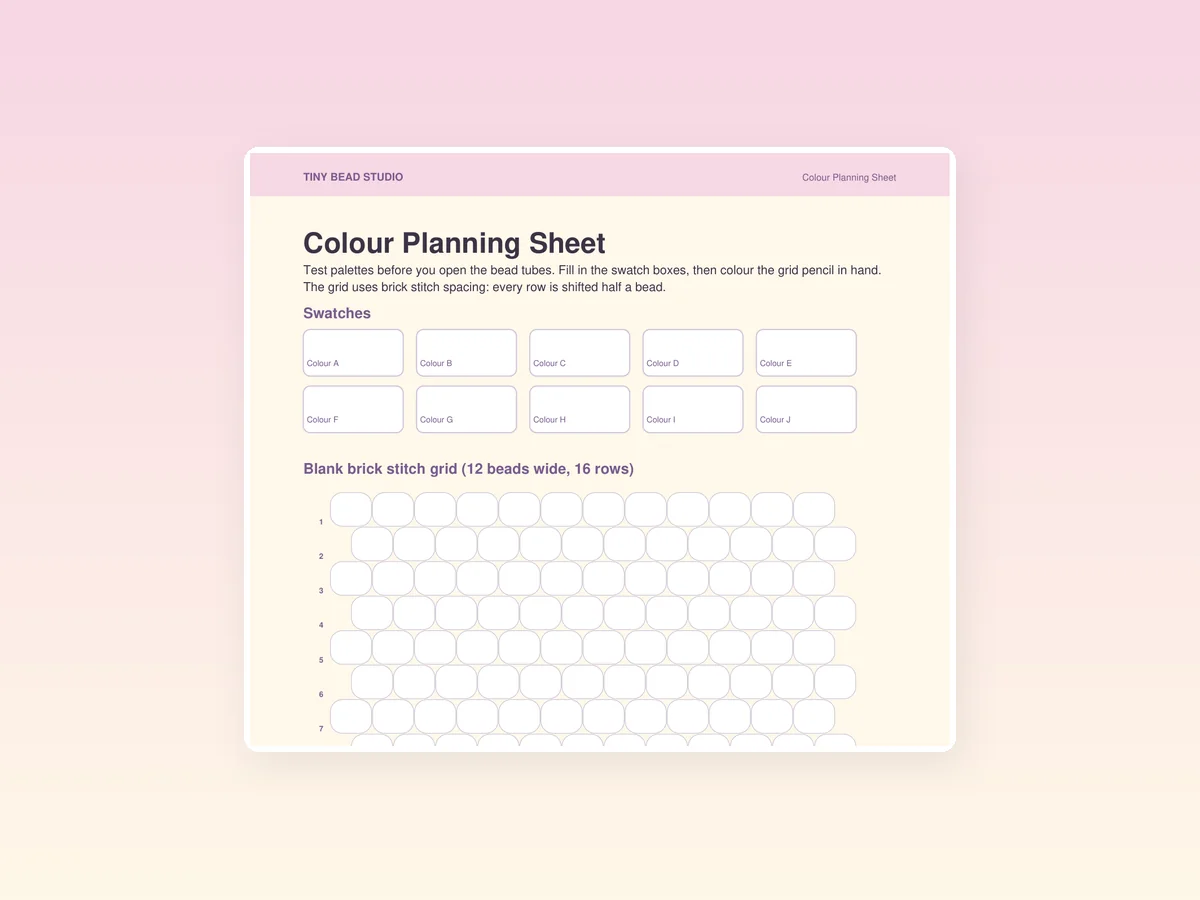
The pack also includes a colour planning sheet with blank brick stitch grids. Fill in a palette before you buy anything and you can check your idea against the colour key: the strawberry in pink and cream, the duck in white and orange, a frog in lavender. It is the cheapest way to try a variation, and it keeps you from running out of one shade halfway through.
What you need to buy
For most charts you need:
- Miyuki Delica 11/0 seed beads in the colours of the chart. About 1 g of mixed colours covers a small charm, with spares.
- 6 lb beading thread such as FireLine.
- A size 12 beading needle and a small pair of scissors.
- An earring hook, jump ring or keychain clasp to finish.
If you already bead, this list will not surprise you. If you do not, it is a small shopping basket, not a hobby overhaul.
How to pick a brick stitch pattern pack
Before you buy any set of charts, check:
- Are bead counts printed? If not, you are guessing.
- Is the colour key listed per chart? You want the totals before you shop.
- Is there a beginner guide? Ladder stitch and finishing should be shown, not assumed.
- Does it print at your paper size? Good packs include A4 and US Letter.
- What can you do with the finished pieces? Personal use is standard; ask whether selling your handmade pieces is allowed.
The Beaded Charm Starter Pack covers all five. The files are digital PDFs for personal use; you may sell the physical pieces you bead by hand, but not share or resell the files.
The result
A finished brick stitch charm is small, bright and a little surprising: a frog you made from 71 beads that sits in the palm of your hand. A chart that counts for you is what turns that from a good idea into an evening's work.