Beaded Charm Patterns: Tiny Animals and Food, Counted Row by Row
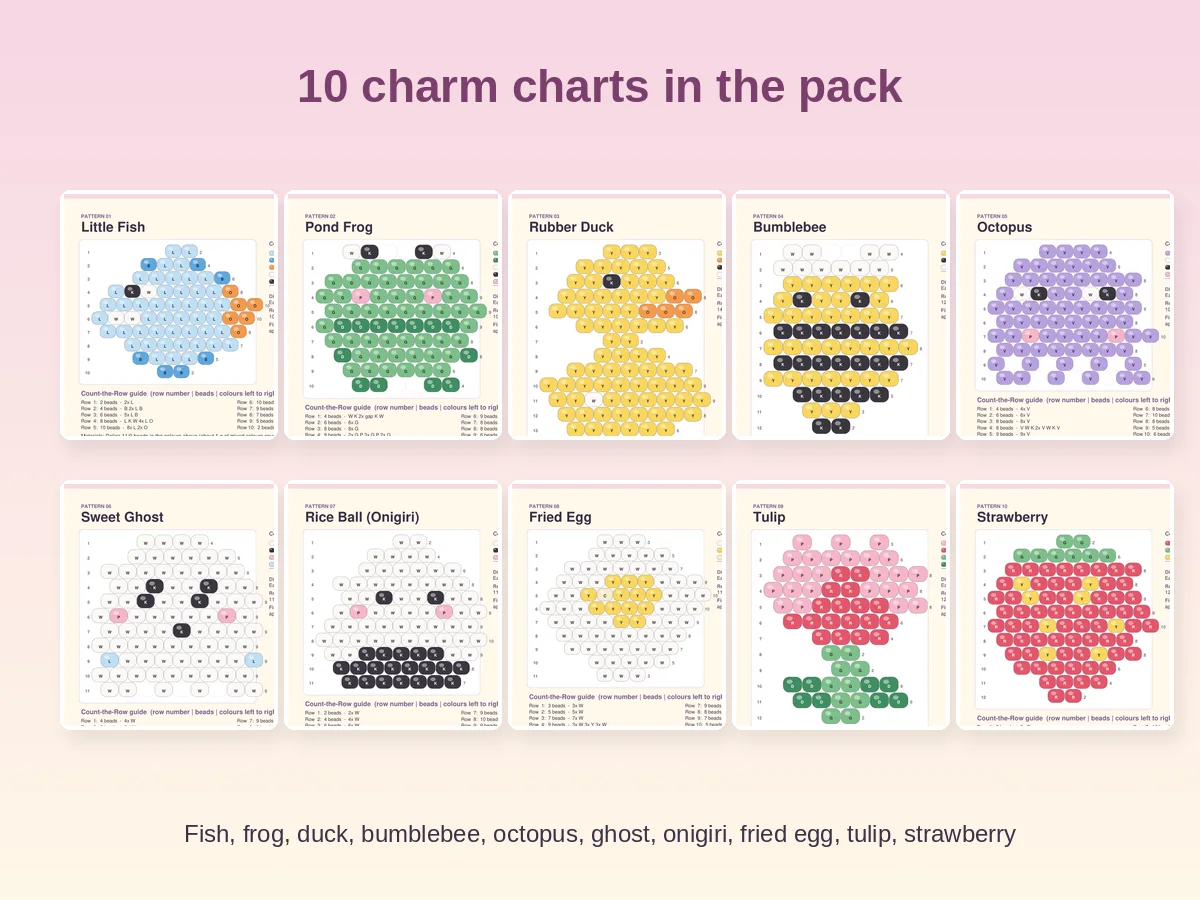
A beaded charm is a flat piece of seed beads, about the size of a fingertip, worked row by row in brick stitch and finished with a clasp, hook or ring. It is a wearable little character: a frog, a fish, a slice of onigiri. The best charm patterns are the ones that tell you what to place in each row, so the result looks like the picture, not like a cousin of it.
Below is what the pattern needs to give you, what the ten charms in Tiny Bead Studio · Beaded Charm Starter Pack look like, and how to turn them into things you actually use.
What makes a charm pattern worth printing
Charms are small, which means every bead is visible. A mistake in a large piece disappears in the pattern; a mistake in a charm shows as a crooked eye. A useful chart for a charm therefore has:
- One bead per cell, drawn to match. You see the shape you will get.
- A row guide with counts. The Little Fish reads: row 1, 2 beads; row 2, 4; row 3, 6; row 4, 8; row 5, 10; row 6, 10; row 7, 9; row 8, 7; row 9, 5; row 10, 2. You can see the fish swell and taper in the numbers.
- A colour key with totals. Pale blue 46, sky blue 7, orange 6, matte white 3, charcoal 1: 63 beads in all.
- A materials line with the bead size (Delica 11/0), the thread and the needle.
- A finishing page so the piece does not stay in a drawer as an unfinished hobby.
The ten charms
Little Fish (63 beads). Soft blues with an orange tail and a single dark eye. The classic first charm and the pattern the Start Here guide uses as its example.
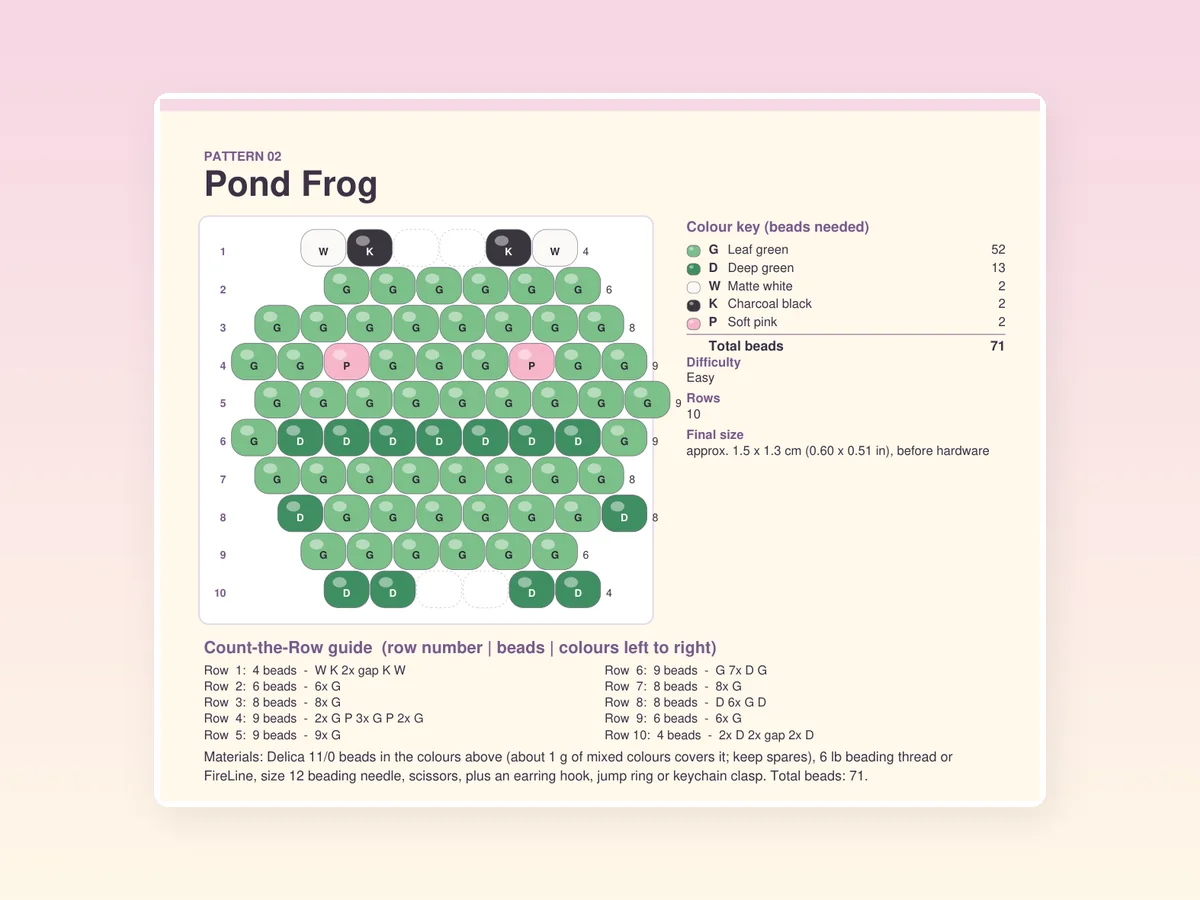
Pond Frog (71 beads). Two greens, pink cheeks, white eyes with black pupils and four small legs at the bottom. It reads as a frog from across the room.
Rubber Duck (85 beads). Yellow with an orange beak. At 14 rows it is the tallest charm of the set and the one that most people recognise at once.
Bumblebee (68 beads). Yellow and black stripes with white wings. Three colours, very symmetric.
Octopus (72 beads). Lavender with pink cheeks and a row of little legs formed by gaps in the last two rows.
Sweet Ghost (86 beads). White with pale blue feet and pink cheeks. The largest by bead count, with a wavy hem.
Rice Ball, Onigiri (80 beads). White rice, a black strip of nori and a small pink centre. It has the tidiest shape of the set.
Fried Egg (76 beads). White with a yellow and cream centre, a small piece with a big personality.
Tulip (61 beads). Pink and red on a green stem. The smallest bead count, and a fine piece for a pair of earrings.
Strawberry (80 beads). Red with scattered yellow seeds and a green top.
Materials, in plain terms
Every chart lists:
- Beads: Miyuki Delica 11/0 in the colours of the key. About 1 g of mixed colours covers a small charm, and it is wise to keep spares.
- Thread: 6 lb beading thread such as FireLine.
- Needle: a size 12 beading needle.
- Scissors, and a dish to pour the beads into so they do not roll away.
- Hardware: an earring hook, jump ring or keychain clasp.
Delica beads are cylindrical and very even, which is exactly why they are the standard for flat brick stitch work: the rows sit flush and the shape on your table matches the chart.
From one charm to a set
Charms are great because they come in sets. Some combinations people tend to like:
- Pond life: frog, fish, duck. Three charms on one bag zip.
- Snack time: onigiri, fried egg, strawberry. Cute on a pencil case.
- Garden: bee, tulip, strawberry. Earrings, one pair each.
- Spooky sweet: ghost and octopus in two palettes.
The planning sheet in the pack helps here. It has blank brick stitch grids so you can colour a pattern before you buy beads: a ghost in lilac, a frog in cream and orange, a duck in pastel. You can compare the colour key totals and see how many of each shade to order.
Make it wearable
The charm is only half the project; the other half is finishing. The Start Here guide explains the essentials: weave in the tail, add the hardware, and choose it by size. Small charms of under 1.5 cm wide want earring hooks with a fine jump ring; medium ones can take a lobster clasp. A keychain is the simplest finish: a jump ring through the top bead loop and a clasp.
For finishing details beyond that (hanging loops built as you stitch, chain made with ladder stitch for bag charms, how to secure knots), there is a separate Earring & Keychain Finishing Guide, sold separately from the starter pack.
A first evening
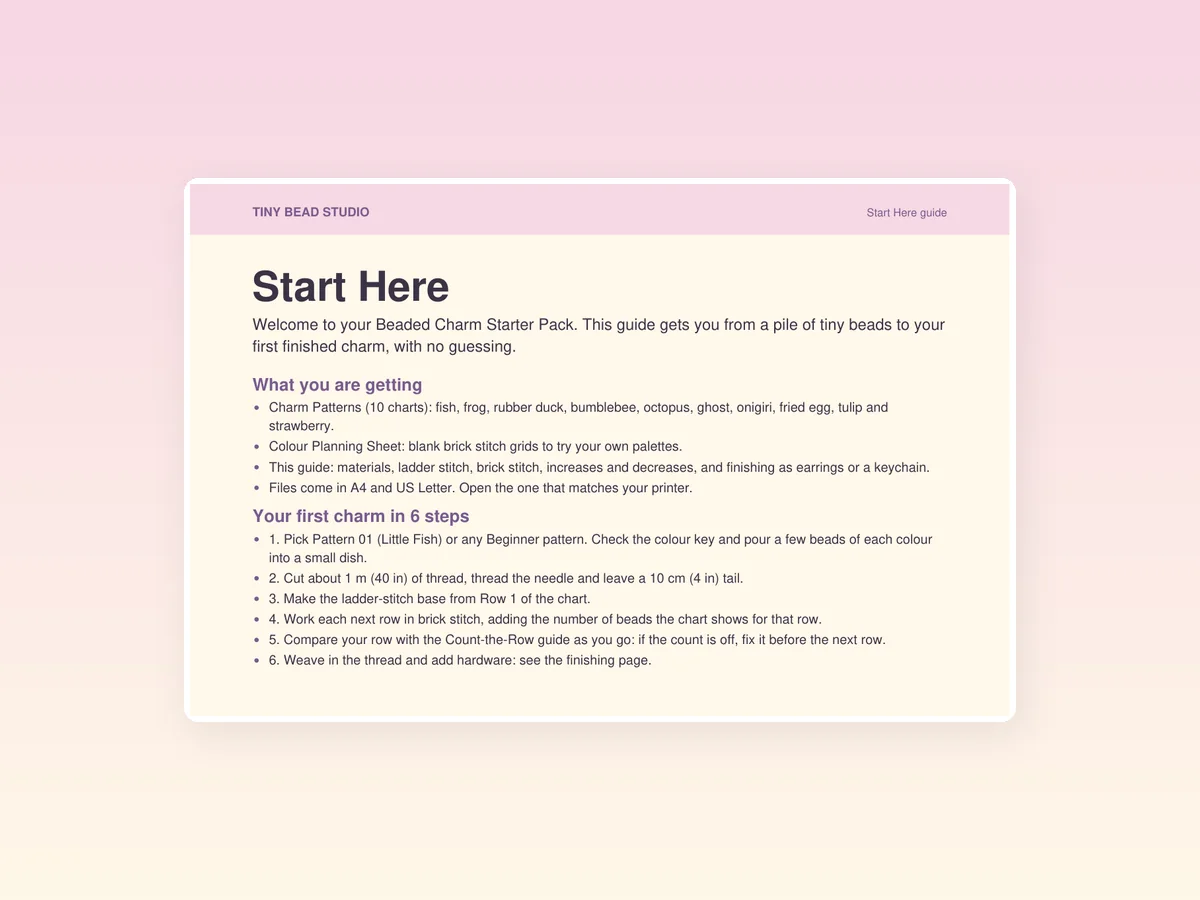
- Choose the Little Fish. Read the colour key and pour a few beads of each colour into a small dish.
- Cut about 1 m of thread, thread the needle and leave a 10 cm tail.
- Build the ladder-stitch base from row 1 (2 beads).
- Work each next row in brick stitch, adding the number of beads that row states. Compare as you go.
- When the last 2 beads are on, weave in the thread and add hardware.
If a row comes out wrong, you find out at that row, not at row nine.
Why it works as a gift
A bead charm is small enough to go in an envelope, personal enough to feel hand-made and fast enough to make several. Make the Frog for a friend who loves them, the Onigiri for a ramen night, a Bumblebee pair for a sister who gardens. Because the pattern states the colours, you can match a bag or a jacket.
Selling your charms
The files are for personal use, and you may sell the physical pieces you bead by hand. You cannot share or resell the PDFs. If you are thinking about a stall, the Sell Your Charms Kit and Pricing Sheet are sold separately; start by making each design twice so you know how long a piece really takes.
What you will have at the end
Ten charms, each with a chart, a key and a count; a Start Here guide with ladder stitch, brick stitch, increases, decreases and finishing; a colour planner; A4 and US Letter files. The first charm will be done tonight. The second will go faster.