Best Seed Beads for Brick Stitch: Delica 11/0, Thread and Needle
For brick stitch, the best seed beads are Miyuki Delica 11/0: tiny cylinders with thin walls and large holes, so each row sits flat and the thread can pass through the beads several times. Round seed beads can be used, but the look is softer and the rows less regular. If you want the neat, tiled finish of a charm chart, Delica is the bead the charts are drawn for.
This guide compares the options, shows how many beads to buy and describes the thread and needle that go with them. The examples come from the ten charts in Tiny Bead Studio · Beaded Charm Starter Pack.
Delica versus round seed beads
| Delica 11/0 | Round seed beads 11/0 | |
|---|---|---|
| Shape | Cylinder, flat ends | Round, slightly uneven |
| Hole | Large, regular | Smaller, varies |
| Rows | Sit flush, tile like bricks | Wavy, slight gaps |
| Best for | Flat charms from charts | Fringe, embroidery, loose weaving |
| Thread passes | Many, with ease | Fewer before the hole fills |
In brick stitch, you go through the same beads several times, and a charm has to hold a key ring. Large, regular holes matter more than any other property. That is why the materials list on every chart in the pack specifies Delica 11/0 colours.
How many beads you need
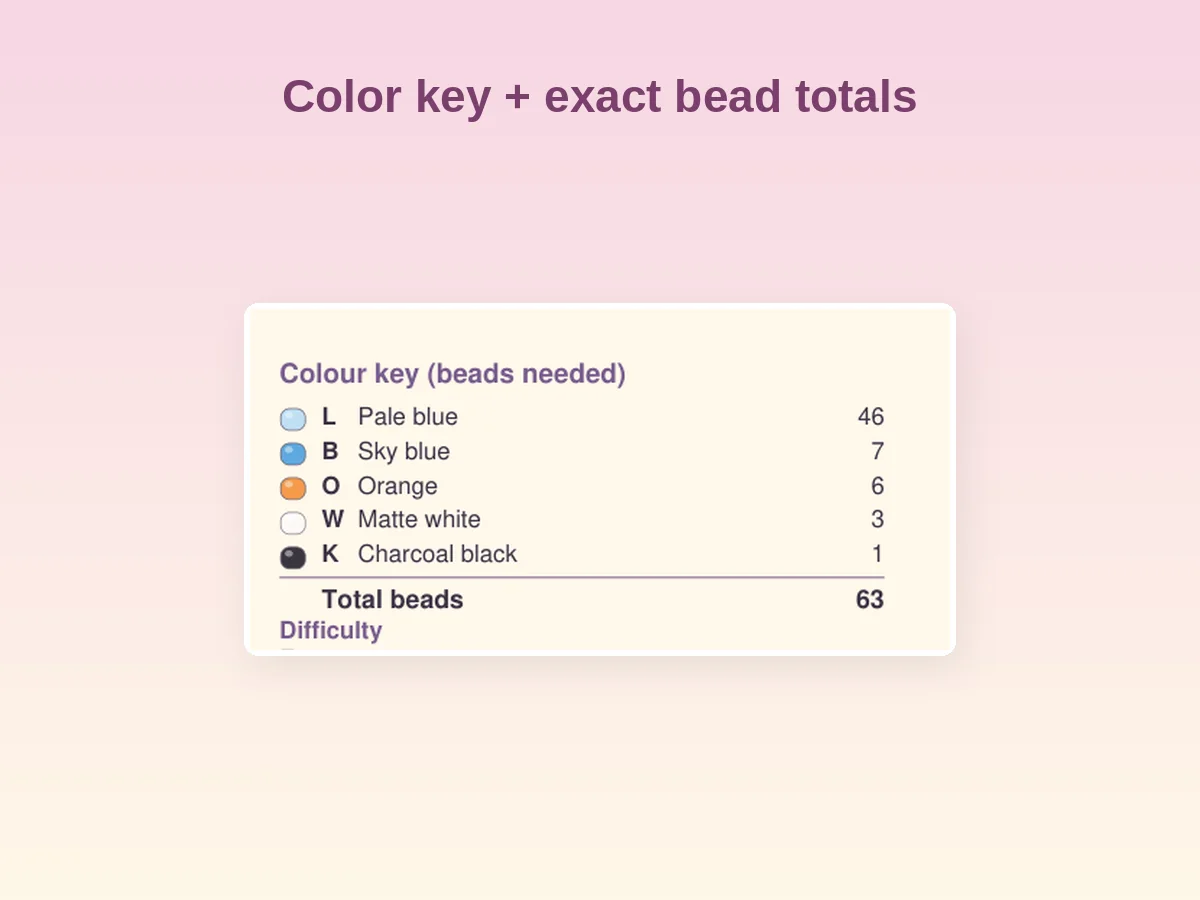
Do not guess, and do not buy a whole tube of each colour. The colour key of each chart gives the exact totals. Take the Little Fish:
- Pale blue: 46
- Sky blue: 7
- Orange: 6
- Matte white: 3
- Charcoal black: 1
- Total: 63
About 1 g of mixed colours covers a small charm, spares included. Across the ten charms, the full set uses 742 beads. If you plan to bead all ten, the most used colours will be matte white, charcoal black and soft pink, because they appear on many charts: charcoal on seven of the ten charts, and matte white on eight.
A practical approach is to buy small packets of each colour in the pack's palette, which comprises 12 shades across the ten charms: matte white, charcoal black, strawberry red, soft pink, orange, sunny yellow, leaf green, deep green, sky blue, pale blue, lavender and cream. Order the colours for the charts you plan to bead first.
Colour names and finishes
Bead brands use catalogue numbers, so what is a "sky blue" in one range may not match another. Two things help:
- Buy colours from the same range. Matte and glossy finishes look different together. A matte white and a glossy pale blue on the same fish will not look like the picture.
- Match by sight, not by name. The chart colours are on the screen as soft tones; hold your beads in daylight and pick the nearest match.
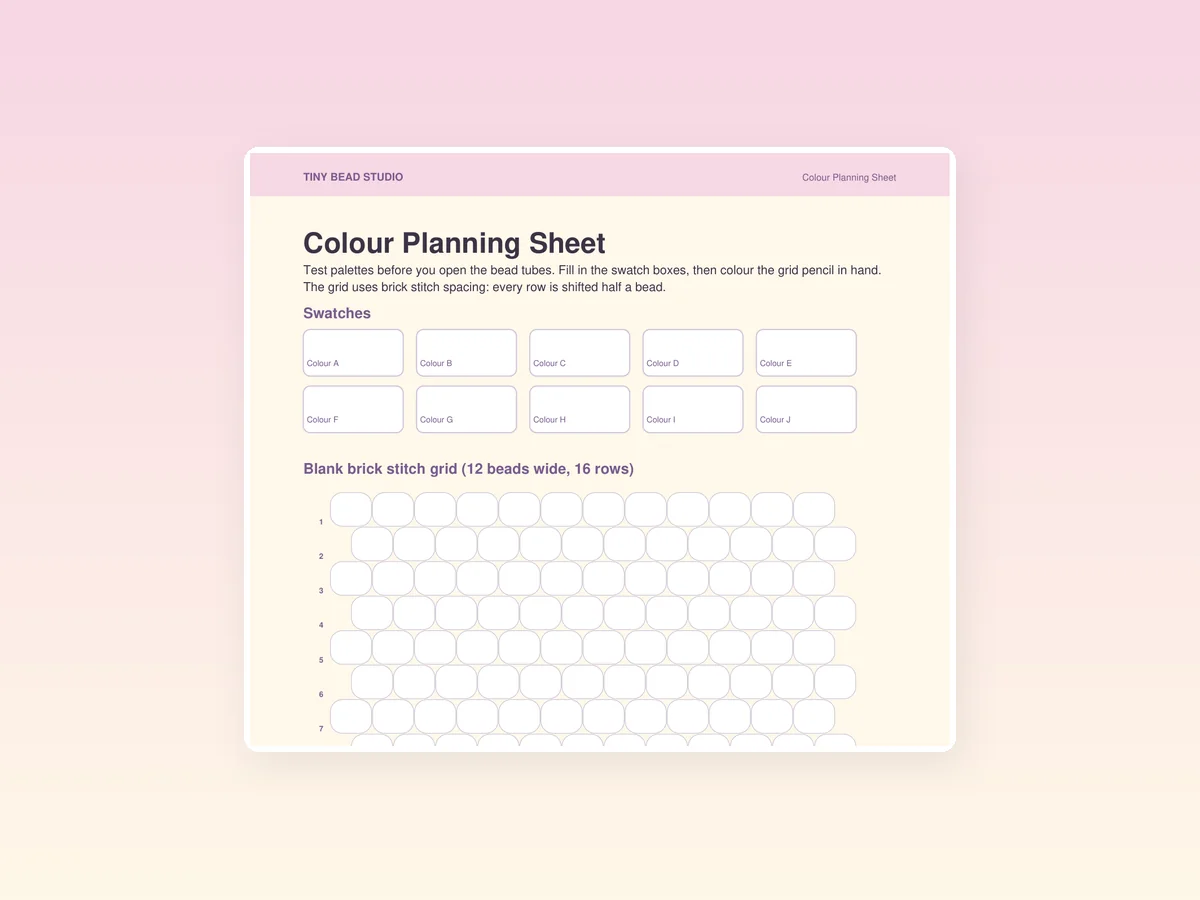
If a shade is out of stock, use the colour planning sheet to try a substitute and see whether the charm still reads: a lavender octopus becomes a pink one, a green frog becomes a yellow one.
Thread: 6 lb beading thread
The thread is as important as the bead. Use a beading thread such as 6 lb FireLine: it is thin, strong and does not stretch. Cotton or polyester sewing thread splits on bead edges and can snap under key-ring tension. About 1 m (40 in) per charm is plenty, with a 10 cm (4 in) tail at the start.
Needle: size 12
A size 12 beading needle fits through 11/0 bead holes, even after several thread passes. If the needle starts to struggle in the later rows, where the thread has already passed through the same beads several times, ease off rather than forcing it. Keep a spare, because beading needles bend and break.
Tools that help
- A bead dish or tray, so you pick beads up, not off the table.
- A felt or non-slip mat, which stops beads rolling.
- Small scissors that cut beading thread cleanly.
- Pliers for hardware.
- Good light. Black beads vanish in poor light. Work by a window, or with a daylight lamp.
Avoiding "I ran out of one colour"
The classic beading disaster is a missing bead in the final row. To avoid it:
- Read the colour key before buying.
- Add 10 to 15 percent spare beads of every colour, especially for the single-bead details such as eyes.
- Keep unused beads in labelled small bags for the next charm.
The key also tells you how fiddly a charm is: the Little Fish has a single charcoal bead for an eye, so a short mistake is easy to fix, but a single missing bead is not.
A first shopping list, colour by colour
If you are starting with the three easiest charms, the shopping list is short. For the Little Fish you need pale blue, sky blue, orange, matte white and charcoal. The Bumblebee adds sunny yellow and uses the same white and charcoal. The Rice Ball uses matte white, charcoal black and soft pink, so after those three charms you have bought only seven colours and can bead three animals, with spare beads for a fourth. That is how a small first order turns into a collection. The colour planning sheet lets you tick the colours off as you decide, and reading the colour key of the next charm tells you what to add to the basket.
Cost thinking
Seed beads are inexpensive per charm. You buy a small packet of each colour and it covers several charms, because charm sizes are measured in tens of beads, not hundreds. The pack itself is a one-time payment for the digital files; beads, thread and needles are separate and you buy them where you like.
Which beads should you not use
- Mixed bags of random seed beads. Sizes vary, and a chart is drawn with regular beads in mind.
- Large beads such as 6/0 or 8/0. They give a bigger piece, but the chart will be lopsided in proportion and the Count-the-Row guide still works. They are an interesting variation once you know the pattern.
- Faceted or unusual shapes. They interlock differently.
Putting it together
Choose a chart, read the colour key, buy the beads from one range, use 6 lb beading thread and a size 12 needle. That is the shopping list for a charm. The Start Here guide in the pack walks through the first project with all of this in mind.
You may sell the charms you bead by hand; the PDF files are for personal use and cannot be shared or resold.