Beaded Charms to Sell: Pick Designs, Count the Costs, Check the Licence
Beaded charms are one of the cheapest handmade products to start selling: a charm of 60 to 90 beads uses about a gram of beads, a little thread and a clasp, and it fits in an envelope. What decides whether it pays is not the cost of beads. It is how long each piece takes you, and whether you picked designs people want.
This guide covers design choice, cost per piece and a realistic way to check your time, using the charts in Tiny Bead Studio · Beaded Charm Starter Pack.
What the licence allows
Start with the rule, so there are no surprises. The files are digital PDF patterns for personal use. You may sell the physical pieces you bead by hand. You may not share, resell or redistribute the files. Results depend on your beads, tension and practice. Not affiliated with Miyuki, Toho or any bead brand.
That means: bead the charm, sell the charm, do not sell the chart.
Which designs are worth making
For selling, a charm should be recognisable in a second, cheerful and small enough to ship cheaply. Of the ten in the pack:
- Little Fish and Pond Frog, the animal charms.
- Rubber Duck and Bumblebee, bright and instantly readable.
- Strawberry, Fried Egg and Rice Ball, the food group with a built-in following.
- Tulip, which suits earrings.
- Sweet Ghost and Octopus, good for autumn stalls and playful shops.
Build a range, not a pile: pick five or six, and make them in two or three colourways each. The colour planning sheet lets you decide which colourways before you order.
Working out your cost per piece
Costs per charm:
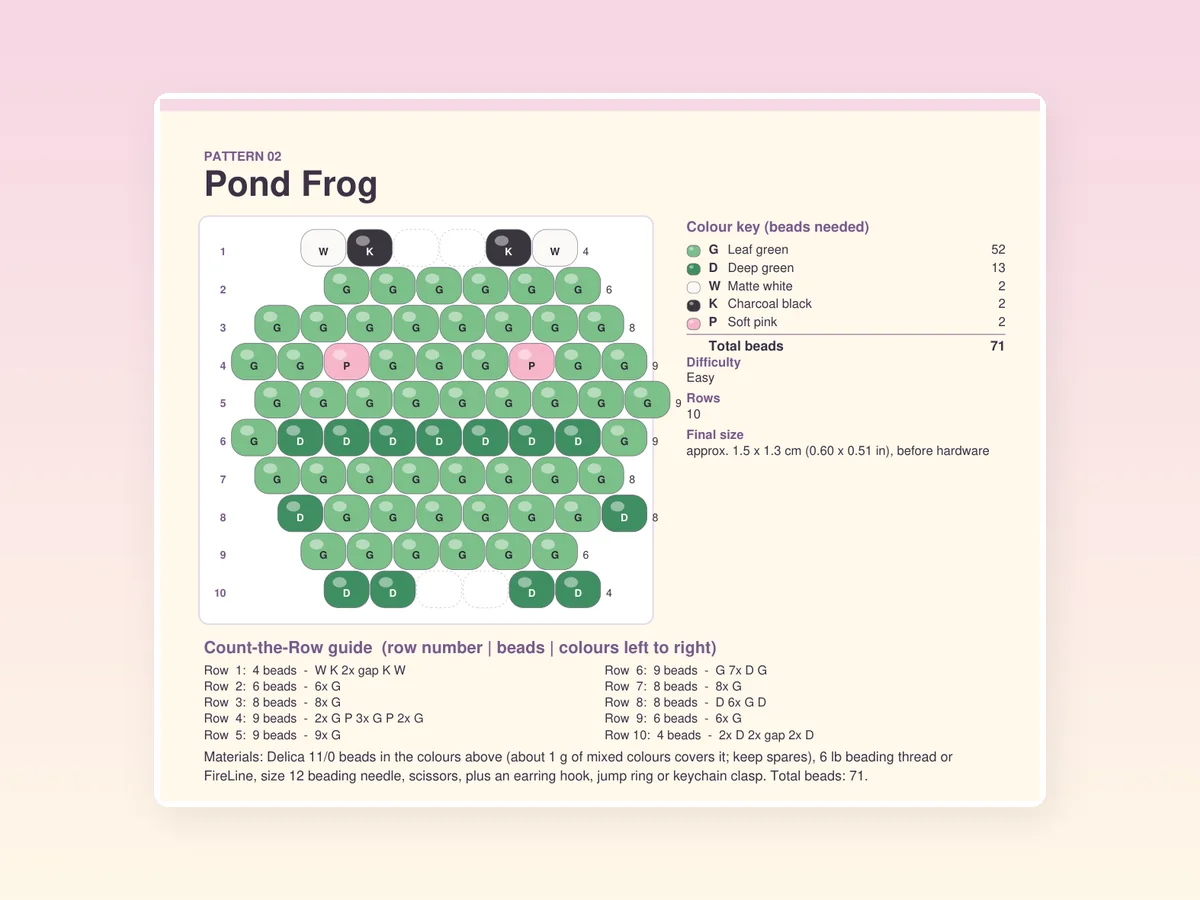
- Beads. The colour key lists the exact count. A small charm uses about 1 g of mixed colours with spares.
- Thread. About 1 m (40 in) per charm.
- Hardware. A jump ring and a clasp or earring hook.
- Packaging. A small card or bag.
- Your time. This is the largest cost, and the one most beginners ignore.
For the Little Fish, 63 beads in five colours: write the total beads of each colour, count the hardware, and you have your material cost in a few minutes. Multiply for a pair of earrings.
Measure your time properly
Your first charm takes an evening and tells you nothing about a business. Bead the same charm three times and time the third. That is your realistic time per piece. Then decide:
- Is the hourly rate acceptable for this design?
- Which designs have a better ratio? A Tulip of 61 beads is faster than a Ghost of 86.
- Can you batch? Beading six fish in a row is faster than six different animals, because you pre-sort the beads.
If the numbers do not work for a design, you can make it your showpiece at a higher price and keep fast designs as your volume.
Batching: how experienced makers work
Pour the beads for six charms into six small dishes. Thread six needles. Make row 1 on all six, then row 2 on all six. It sounds slow, but the rhythm is faster, and mistakes show at once because you can compare the six side by side. When the fish are done, hardware them all in one session.
Photographing and presenting
Use plain linen or paper, daylight and a macro or close-up setting. Show scale: a charm next to a coin or a finger. Photograph on a keychain and as earrings. Three pictures per product is enough.
Name designs by what they are: Little Fish charm, Pond Frog earrings. Describe size (the Little Fish is about 1.7 x 1.3 cm before hardware), the beads used (Miyuki Delica 11/0) and the finishing (lobster clasp, earring hooks).
Seasonal charms
Sales cluster around holidays. A Christmas tree, a snowman, a gingerbread friend, pumpkins and cats for October. These are not in the starter pack; they are in separate seasonal packs sold separately. Plan ahead: bead them six weeks before the season.
Pricing
Price from your cost, not from what you think people will pay. Use this approach:
- Material cost per piece.
- Plus your time at a fair hourly rate.
- Plus fees (marketplace, payment, shipping).
- Check the price against similar handmade charms.
A Pricing Sheet and Order Log is available separately; a spreadsheet of your own works too.
A sample week for a small stall
Imagine you want a table of twenty pieces. Pick four designs, say the Little Fish, Pond Frog, Bumblebee and Strawberry, and make each in three colourways except the bee, which has only its natural palette. That is ten charms, plus five pairs of tulip earrings in two colours. Sort beads the day before. On evening one, bead the four first rows of every charm. On evening two, the second set. By the end of the week, hardware and card everything in one sitting. The planning sheet records each colourway, so a customer who wants another fish in lilac next month gets the same one. Keep the printed charts in a folder with a note of the colours you used, and you will never have to guess what you made.
Quality control
Every piece you sell should pass three checks: jump ring closed, tail secured, front and back clean. Hang it from the clasp and shake gently. If a bead moves, redo it. A reputation for pieces that last is the cheapest marketing.
Starting small
You do not need a shop to begin. Sell to friends, make a few for a local market, or open a small listing. Keep notes of which designs people ask about. After a month, you will know where to put your next evenings.
Summary
Charms are low-cost, fast to learn and easy to give. A counted chart tells you the bead total and the row count of every piece, so you know your cost before you start. Choose five or six designs, time the third one and price from there. And keep the licence rule in mind: sell the charms, never the files.