Printable Bead Patterns PDF: What a Good One Includes
A printable bead pattern PDF is worth buying when it does the counting for you: every bead drawn, every row numbered, every colour totalled. The file should print cleanly on the paper you own, sit flat beside your beading mat and let you tick off rows with a pencil.
Here is a short checklist for judging a pattern before you buy, followed by what the Tiny Bead Studio · Beaded Charm Starter Pack PDFs contain.
The checklist
- Every bead is drawn, with a letter or colour. A photo of a finished piece is not a chart.
- Row counts are printed. "Row 5: 10 beads" is the difference between catching a mistake now and finding it at row nine.
- A colour key lists totals. You want to know you need 46 pale blue and 1 charcoal before you shop.
- A materials list names the bead type, thread and needle.
- Starting and finishing are explained. Ladder stitch, increases, decreases, earrings, keychains.
- The page size matches your printer. Look for A4 and US Letter.
- The licence is clear. Can you sell what you bead?
If a PDF fails two or more, keep your money for one that does not.
What the charts in the pack look like
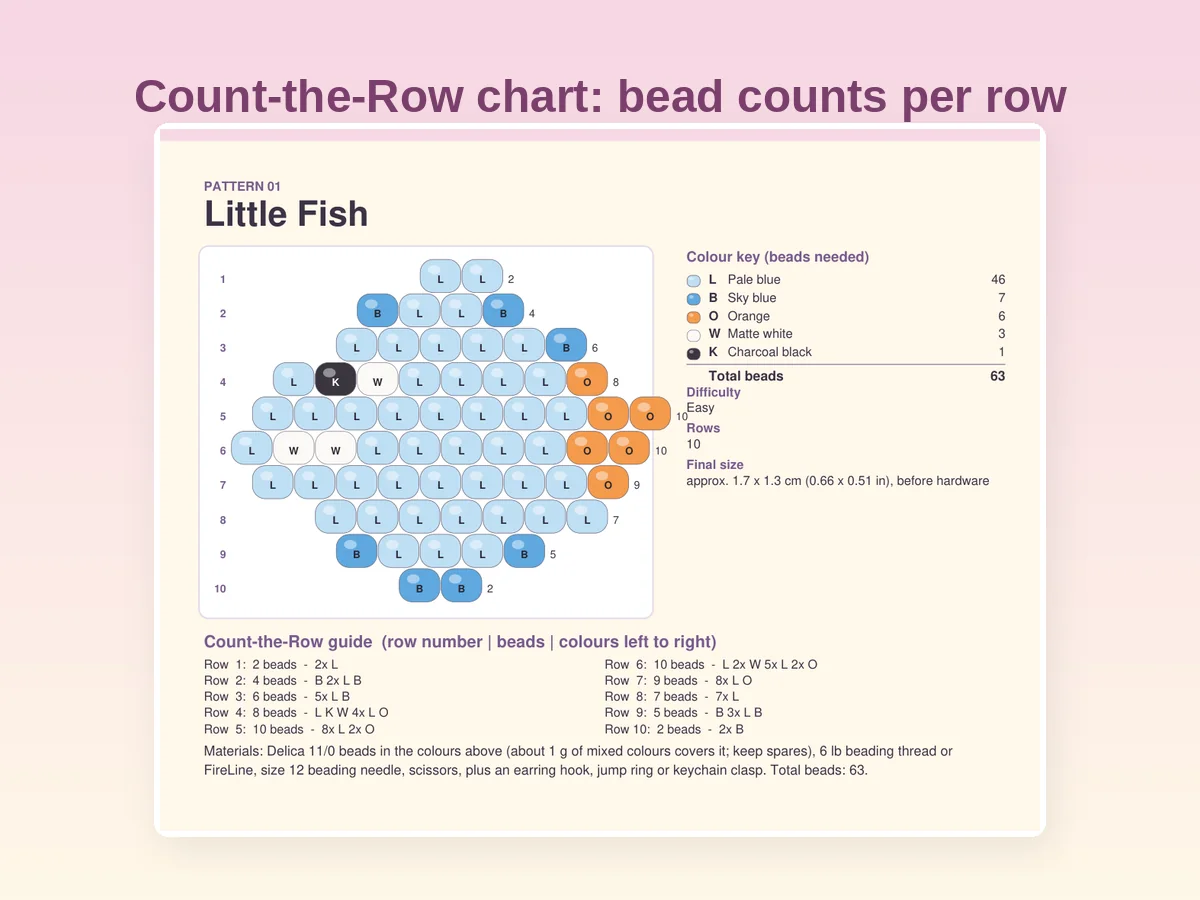
Each of the ten charts is a landscape page. On the left is the chart: rounded bead shapes, staggered like bricks, each with a letter. On the right is the colour key with the number of beads per colour, the difficulty level, the number of rows and the final size. Below is the Count-the-Row guide: row number, number of beads, colours left to right. At the bottom is a materials line: Delica 11/0 beads, 6 lb beading thread or FireLine, a size 12 needle, scissors and hardware.
Take Pattern 01, Little Fish: 10 rows, 63 beads, easy, about 1.7 x 1.3 cm before hardware. Row 6 reads: 10 beads, L 2x W 5x L 2x O. That one line tells you which bead to pick up in which order.
Printing without surprises
Beading charts are small, so print scale matters less than for a quilt template, but a few rules help:
- Print at 100 percent, not Fit to page.
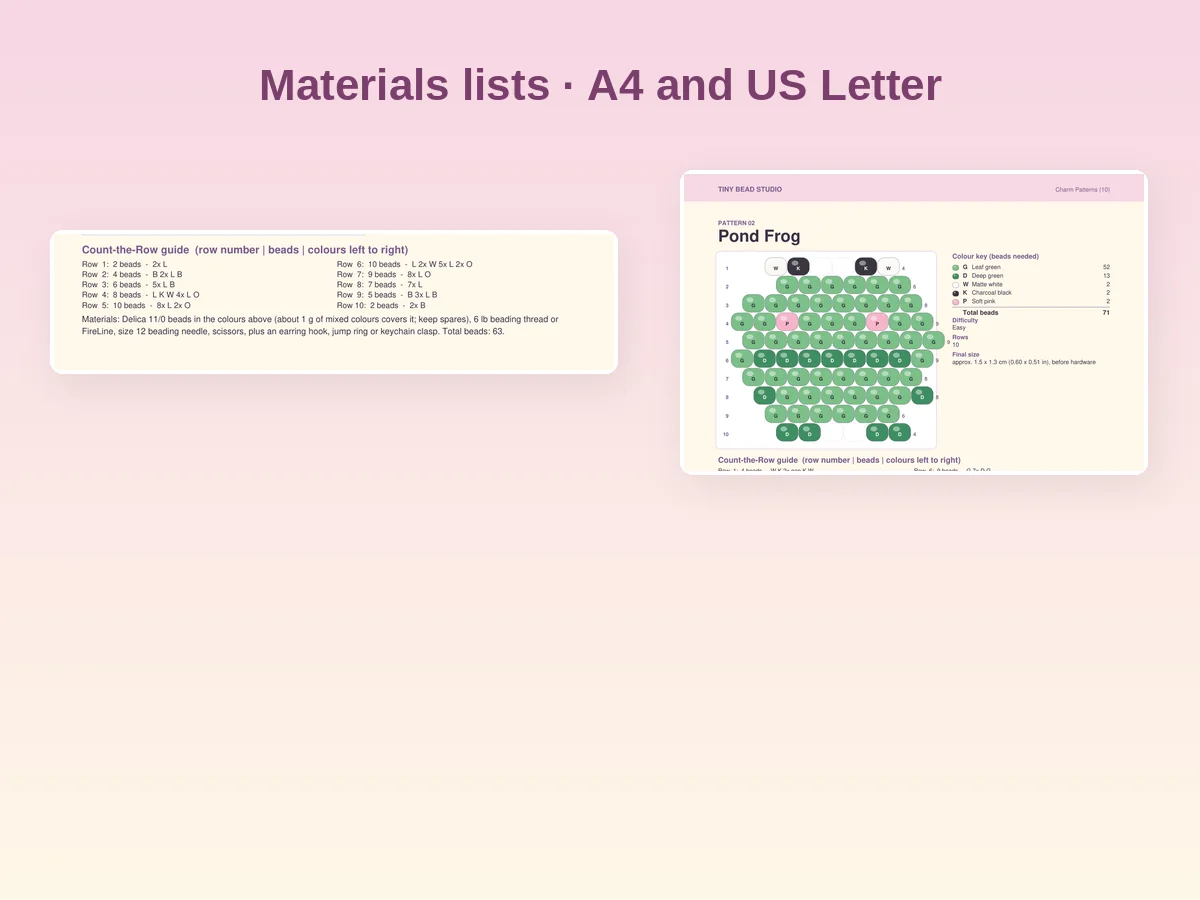
- Pick the right file: names ending in -a4 are for A4, those ending in -letter are for US Letter.
- Use a plain paper setting unless you want to laminate.
- Print the chart you are beading, not the whole pack. Ten charts are on one document, so print only the page you need.
- Black and white is not enough. The charts rely on colour; use a colour printer, or print in black and white and mark the letters.
Working with the paper
Many beaders like paper for three reasons: you can tick rows with a pencil, you can lay the chart flat beside the mat, and the screen does not time out in the middle of a row. Some tricks:
- Slip it in a plastic sleeve and tick rows with a washable marker.
- Tape a ruler under the row you are working on, so your eye does not jump.
- Keep a printed copy per colour palette. Write on it the colours you used.
If you prefer a tablet, zoom in on the chart so the beads are larger than life. For the row guide, keep the paper nearby.
What is in the pack
- Charm Patterns: 10 charts for a fish, frog, rubber duck, bumblebee, octopus, ghost, onigiri, fried egg, tulip and strawberry.
- Start Here guide: materials, ladder stitch, brick stitch, increases and decreases, a six-step first charm and finishing as earrings or a keychain.
- Colour planning sheet: blank brick stitch grids.
- A4 and US Letter versions of every file.
The delivery is instant and the payment is one-time. There are no subscriptions and no shipping.
Pattern or tutorial video?
Videos are good for seeing the thread path. Charts are better for knowing what to do next. Many people use both: a video to learn ladder stitch, a chart to place the beads. The PDF's Start Here guide has the thread path drawn on the chart, so a video becomes optional.
Why PDFs beat a printed book for beading
A printed book is a fixed set of designs and a spine that resists lying flat. A PDF can be reprinted if you spill beads on it, enlarged at the copy shop, and kept on your phone in the craft store while you choose colours. You can also print the same chart twice, one to bead from and one to colour with pencils.
Row counts in practice
Here is why a row guide pays for itself. Suppose you are working the Pond Frog and reach row 4, the one with the pink cheeks. The guide says 9 beads, with a pink bead third from each edge. You count and find 8. Without the guide you would carry on, and the frog would end with a missing cheek and a crooked mouth. With the guide you notice at once, pull the last bead out with the needle, and put the right one in. That is the whole value of a counted chart, repeated across every row of every charm, and it is why beginners finish pieces that look like the picture.
A second use is shopping. Add the colour key totals of the charts you want to bead, and you have an order list before you open a bead shop. The Fried Egg needs cream, white and yellow only. The Tulip needs two greens, pink and red.
The licence
The pattern files are digital PDF patterns for personal use. You may sell the physical pieces you bead by hand. You may not share, resell or redistribute the files. This is the same rule most pattern designers use, and it keeps the price low for everyone.
A good first print
Open the Start Here guide and Pattern 01. Print both on one sheet each. Pour a few beads of each colour into a dish. Thread the needle. In about an hour, you will have a charm in your palm.