Christmas Tree Quilt Pattern: How to Choose and Where to Start
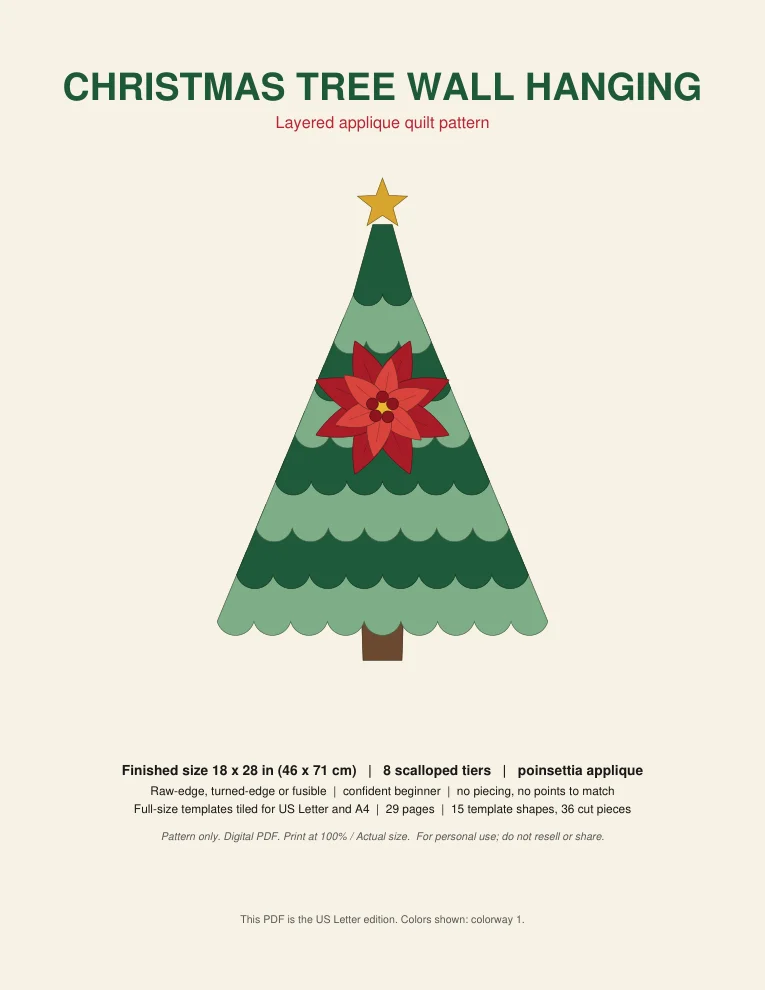
Searching for a Christmas tree quilt pattern gives you very different projects under the same name. Some are bed quilts made of small tree blocks, some are simple appliques on a rectangle, and some are single trees that hang on a wall. If you pick the wrong kind, you may end up with a project far bigger or harder than you wanted.
This guide sorts the main types, shows what each one asks of you and describes what a good pattern PDF should include before you buy.
Type 1: pieced tree blocks
A tree block is a small square or rectangle made of triangles and strips, with a trunk. You sew many of them and join them, so the finished size is a throw, lap or bed quilt, or a long table runner.
What it asks: accurate cutting and a consistent quarter-inch seam. Points need to meet at the tree top and tiers. What you get: a traditional patchwork look and a quilt you can use. Time: weeks.
If you like this style, see Christmas tree quilt blocks compared with layered trees.
Type 2: applique tree on a background
A single tree shape is appliqued onto a rectangular background. The outside edge stays straight, so a regular binding is enough. Many designs add ornaments, stars or snow.
What it asks: applique cutting and stitching, and a little layout planning. What you get: a framed, picture-like hanging. Time: a weekend.
Type 3: a layered tree with scalloped tiers
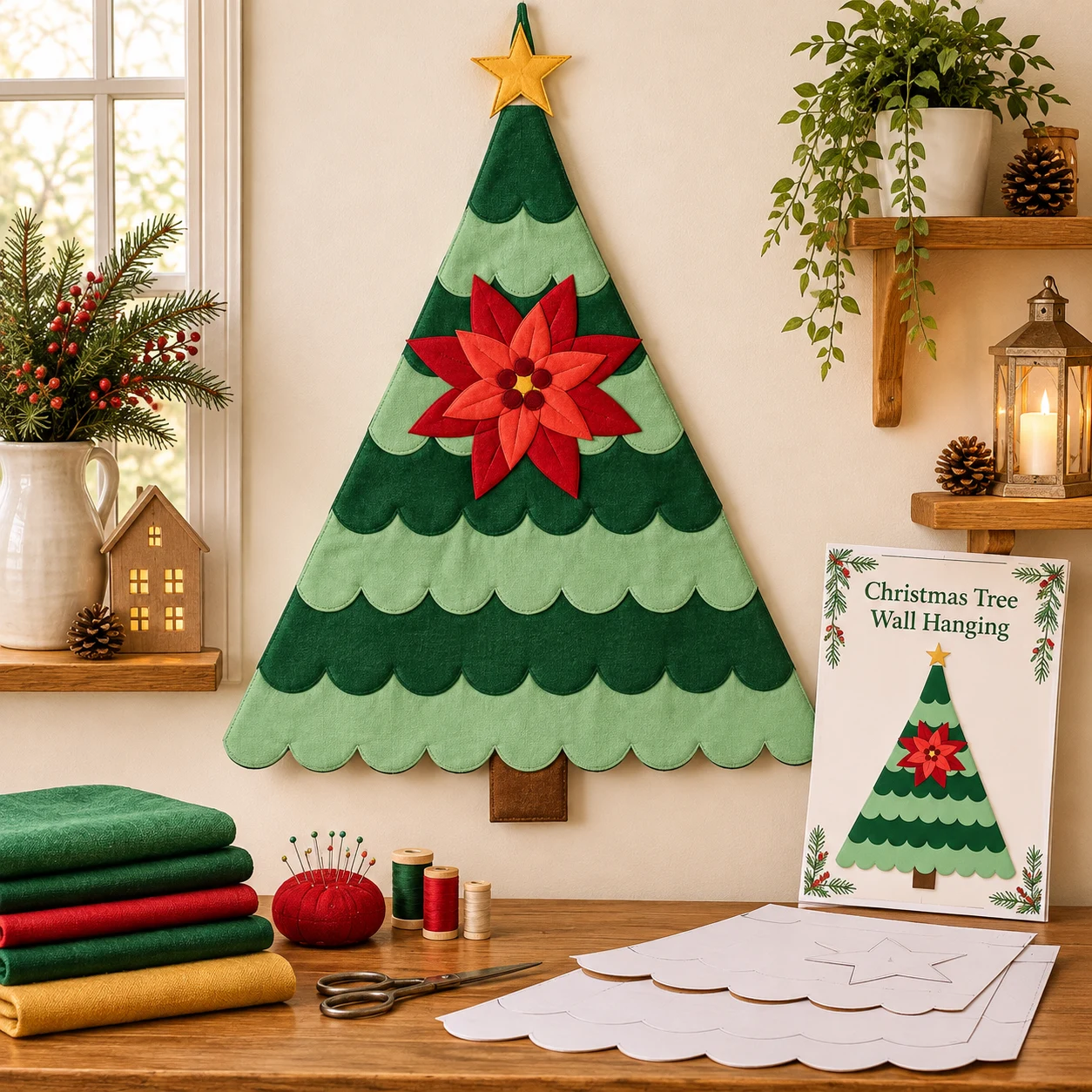
A layered tree stacks overlapping scalloped tiers from the widest at the bottom to the narrowest at the top, with a trunk and an optional star. The silhouette is the tree: the binding follows the scallops all the way around.
The Pine & Thimble Christmas Tree Wall Hanging Pattern is one of these. Its details:
- Finished size 18 x 28 inches, with a mini at 9 x 14 inches.
- Eight scalloped tiers, nominally 3 to 17 inches wide.
- A poinsettia centerpiece with six leaves, eight outer petals, six inner petals, a center and five berries.
- Edge treatments: raw-edge, turned-edge or fusible.
- Instructions: 12 pages, an assembly map and tiled templates for Letter (15 pages) or A4 (16 pages).
What it asks: cutting from templates, edge stitching and bias binding. No seam intersections to match. What you get: a sculptural, soft-edged tree that looks bigger than the effort. Time: a weekend.
Quick comparison
| Pieced blocks | Applique on background | Layered scalloped tiers | |
|---|---|---|---|
| Typical size | Throw to bed | Wall hanging | 18 x 28 in or mini |
| Seam matching | Yes | No | No |
| Applique | No | Yes | Yes |
| Binding | Straight | Straight | Shaped (bias) |
| Best for | A quilt to use | Framed look | A centerpiece for the wall |
What a good PDF tree quilt pattern includes
Whichever type you choose, check for these before buying:
- A finished size in inches or centimeters. "Wall hanging size" tells you nothing.
- Full-size templates for your paper size, tiled so you can print at home.
- A scale check. A 1-inch square on each page lets you confirm print scale.
- A materials list with backing, batting and binding as well as the fabric for the tree.
- Cutting chart with the number of pieces.
- Step-by-step instructions in order.
- Terms of use. Personal use means you may sew it for yourself and for gifts but not sell the pattern.
If the listing shows none of this, it is either an inspiration page or an incomplete pattern.
Fabric and color planning
Choose a dark and a light for alternate tiers, and test them in grayscale. Add a trunk in brown or grey, a gold accent for the star and the flower center, and green and two reds for the poinsettia.
The pattern has three colorways to start from:
- Classic Evergreen: deep green and light sage tiers, brown trunk, red poinsettia with gold heart.
- Cream and Rust Scrappy: olive and cream tiers, dark chocolate trunk, rust and terracotta flower.
- Frosted Spruce: deep teal and ice blue tiers, grey trunk, white poinsettia with a gold heart.
For a stash-friendly version, see scrappy Christmas tree quilt.
How big should it be?
Measure the wall first. A full 18 x 28 inch tree needs a wall space about two feet wide and a bit over two and a half feet tall, plus your hanging method. A 9 x 14 inch mini works on a door, a shelf or a small gallery wall.
If you are unsure, look at your space and cut paper to the finished sizes. It takes a minute, and it avoids sewing a piece that is too big or too small for the spot you had in mind.
The finishing work you should plan for
Beautiful trees can stall at the binding stage. A shaped outline has scallops and stepped corners, and you ease bias binding around them. The pattern uses 2.5-inch bias strips and about 94 inches of binding for the full size. Practice on a scrap sandwich before the real thing.
For hanging, add a fabric sleeve for a rod or fold two ribbon loops into the binding.
Pick and print
If you want a tree for the wall that you can finish this season, a layered design with printable templates is the shortest route from idea to hanging. Compare other wall hanging patterns or read beginner patterns for more help in choosing.
This is a personal-use digital pattern. Sewing materials are not included.