Christmas Tree Quilt Block: Pieced Triangles or Layered Tiers?
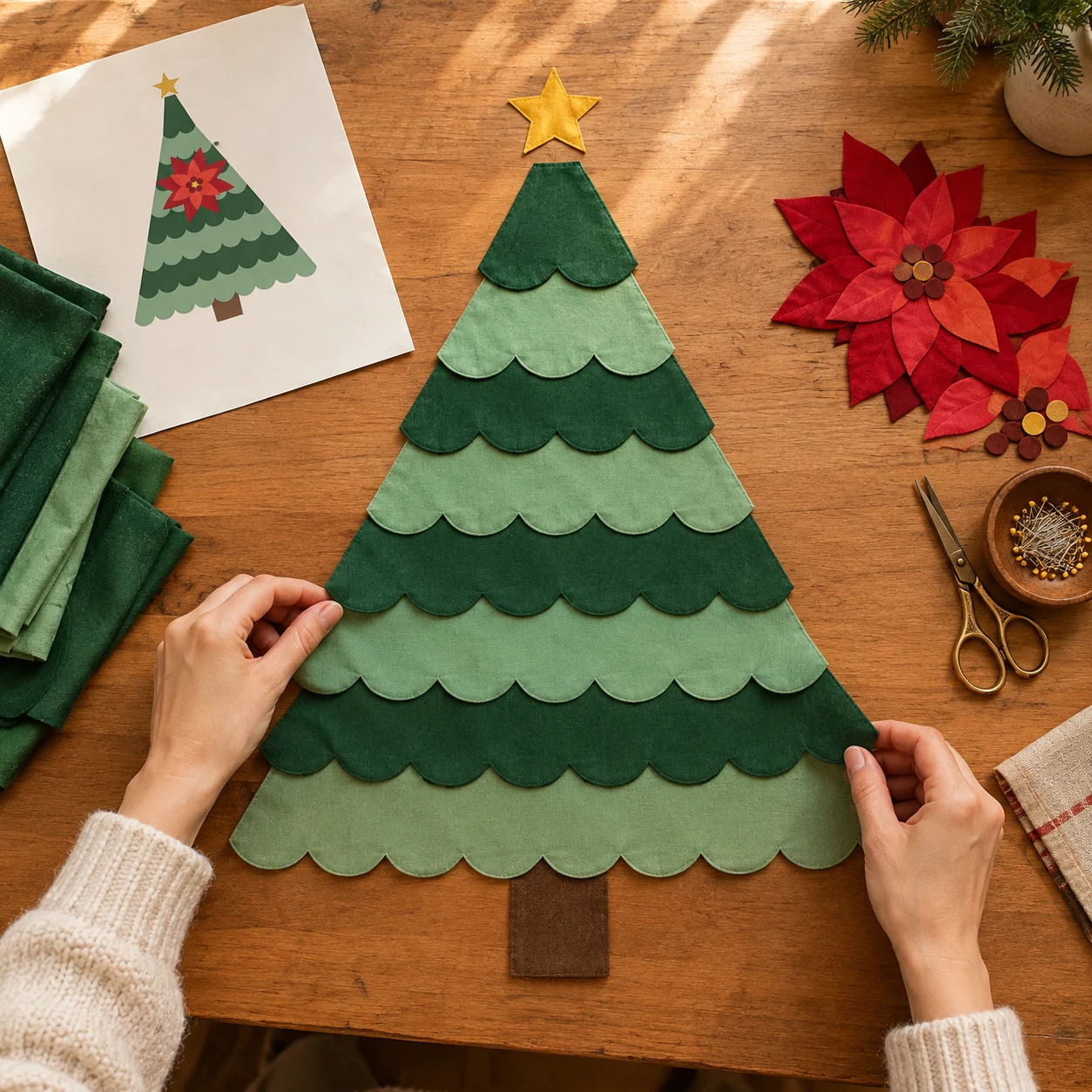
A Christmas tree quilt block is a small tree you sew many times; a layered tree is one big tree you sew once. They look different, they feel different at the machine, and they suit different seasons of your quilting life. Choosing between them takes a minute once you know what each asks of you.
Here is a practical comparison, with the numbers that matter: skill, time, fabric and finished look.
What a tree quilt block is
A tree block is a patchwork square or rectangle, often 6 to 12 inches. Typical versions use a triangle top with strips or triangles stepping outward, a small trunk, and background pieces around them. You make a set, then join them with sashing or straight into rows to make a quilt, table runner or large hanging.
Block patterns are written to be repeated. That is their strength: once you know one tree, the next five go faster.
What a layered tree is
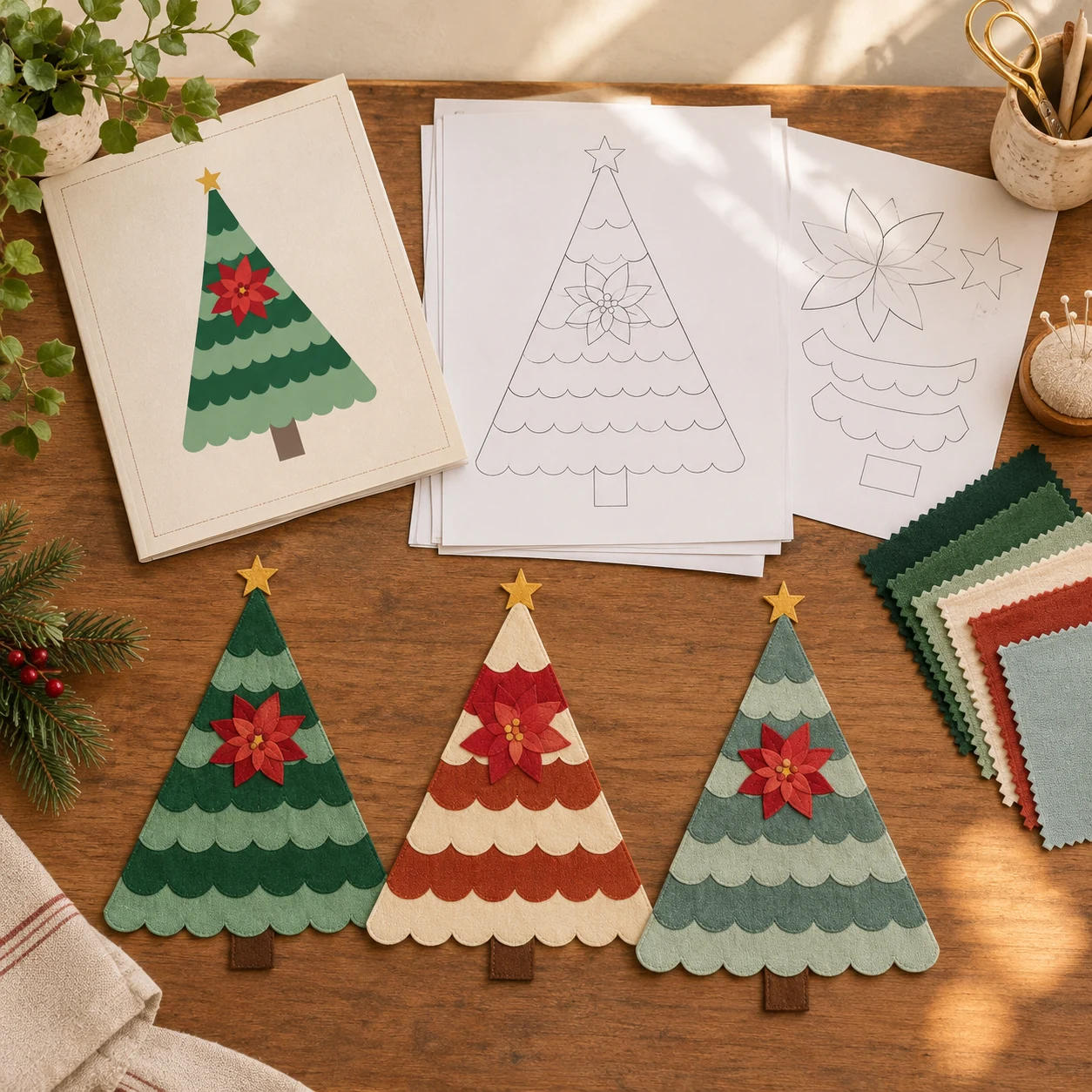
A layered tree is a single design where scalloped tiers overlap, built from widest to narrowest. No triangles and no pieced points. The Christmas Tree Wall Hanging Pattern is an example: eight tiers from 3 to 17 inches wide, an 18 x 28 inch finished size and a poinsettia on the middle tiers.
It is not a block. It is one decorative piece, made once, hung on a wall.
Side by side
| Pieced tree blocks | Layered scalloped tree | |
|---|---|---|
| Main skill | Accurate cutting, quarter-inch seams, matching points | Cutting from templates, edge stitching, bias binding |
| Repeatable? | Yes, as a quilt of many blocks | One design per piece |
| Finished size | Depends on block count: runner to bed quilt | 18 x 28 in, or mini 9 x 14 in |
| Time | Hours per block, weeks for a quilt | A weekend |
| Seam intersections | Many | None |
| Look | Traditional patchwork, geometric | Soft scallops, appliqued, sculptural |
| Fabric | Many fabrics, many small pieces | Two main fabrics plus small scraps |
When pieced blocks make sense
- You love piecing and want a quilt to cover a bed.
- You want to use a large stash of small scraps.
- You like quiet, repetitive sewing.
- You are building a project over many weeks.
Pieced blocks reward planning. Choose your values before you cut: greens in three shades, background lighter than all of them, and a trunk fabric that is clearly darker.
When a layered tree makes sense
- You want a finished piece for this season.
- You are newer to quilting and would like to avoid seam matching.
- You like applique and want a focal point rather than a field of repeats.
- You want something quick to gift.
Because every tier is its own piece and overlaps the next, small cutting errors disappear under the layers instead of showing at a seam.
What a tree takes at the machine
Pieced block. You cut squares and triangles, sew them, press the seams in the right direction, and trim the block to size. A good quarter-inch seam matters. Tree points land at the center and at the sides, and if they are off, the tree looks lopsided. Repeating the block multiplies the checking.
Layered tree. You cut each tier from a template, layer them on the batting from bottom to top and stitch the scallops. The edge stitching secures every layer and quilts the piece. Binding is the one fiddly part: the outline is shaped, so you use bias strips and ease them around curves.
Using fat quarters for either one
Fat quarters work for both, but in different ways.
- Block quilts use several fat quarters per tree row: greens for the tree, a background, trunk brown. Plan a gradient of greens and a consistent background so the trees stand out.
- A layered tree uses one dark fat quarter and one light fat quarter for the eight tiers, with a fat eighth or scrap each for trunk, star, leaves and the two red poinsettia fabrics. Backing and batting are 22 x 32 inches, and binding is about 94 inches of bias strips.
If you are choosing fabrics for a layered tree, the grayscale test helps: take a phone photo of your two tier fabrics in black and white. They should read as two clearly different values.
Reading a pattern before you commit
Whichever style you choose, check these in the product description:
- Finished size in inches or centimeters.
- Instruction format. Written, diagrams, photos or all three.
- Templates or cutting chart. Templates need a scale check.
- Materials with backing, batting and binding.
- Terms of use. Personal use, no resale.
The layered tree pattern includes 12 pages of instructions, an assembly map and 15 tiled template pages for US Letter or 16 for A4, each with a 1-inch scale square, plus the mini templates and three colorways. Its diagrams are schematic drawings rather than photographs.
A good plan for a blocks lover
If you love tree blocks and want to try applique, make the layered tree as a focal piece, then repeat the colors in a block runner. The two pair well on a mantel or table. See how the layered tree compares with other tree designs in Christmas tree quilt pattern: blocks or layered tiers, or change the fabrics with the scrappy tree guide.
Make the choice
Choose blocks for a quilt you will live with for months. Choose a layered tree for a handmade decoration you can finish this month.
This guide is general information. Patterns are for personal use, and sewing materials are not included.