Christmas Applique Patterns: Motifs, Templates and a Project to Start

The best Christmas applique patterns share three traits: bold shapes, honest templates and a clear way to finish the edges. Cute motifs are everywhere. What separates a pattern you finish from one that ends in a drawer is how well it handles the middle part: getting the shapes out of a PDF and onto fabric accurately.
Here are the motifs that work best on quilts, how to judge a template, and a project to try if you want a polished result from a weekend.
Motifs that work on quilts
Applique shapes need to read clearly at wall distance. These are the classics.
- Christmas trees. Layered, scalloped or simple triangles. They suit wall hangings because the silhouette is instantly recognizable.
- Poinsettias. Two rings of petals, leaves and berries. A single flower can be the focal point of a whole piece.
- Stars. Small, easy and good for topping a tree or filling a border.
- Holly and berries. Leaf shapes with small circles, easy for repeating borders.
- Wreaths. A ring of leaves; large but forgiving.
- Gingerbread, mittens and ornaments. Fun for ornaments, table runners and gift quilts.
If you are choosing a first motif, pick a tree and a flower. Large curves are easier than small points.
Judging a pattern's templates
A pattern can look beautiful online and still be frustrating at the table. Check:
- Do the templates print at full size? A pattern that says "enlarge 200 percent on a copier" is a chore.
- Is there a scale check? A 1-inch square on each page lets you verify the print.
- Are tiled pages marked for assembly? Registration triangles and an assembly map save a lot of squinting.
- Are seam allowances shown? A solid line for the cut line and a dashed line for the finished edge keeps methods straight.
- Are paper sizes covered? US Letter and A4 versions mean fewer printing problems.
- Is the number of pieces stated? You should know up front that a pattern has, say, 36 pieces.
The Christmas Tree Wall Hanging Pattern has 15 template shapes producing 36 cut pieces, with a 1-inch control square on every template page, a solid cut line and a dashed finished-edge line, and an assembly map.
The three edge methods in one minute
| Method | Cut on | Finish | Feel |
|---|---|---|---|
| Raw-edge | Dashed line | Straight stitch or narrow zigzag | Soft, slightly frayed |
| Turned-edge | Solid line | Slip stitch or edgestitch | Clean, flat |
| Fusible | Dashed line, traced face down | Satin or blanket stitch | Defined, fast |
The same pattern can be sewn any of the three ways. See Christmas tree applique for how to test each on scraps.
Fabric choices that make applique look professional
- Contrast of value. Shapes must read against the background. A grayscale photo is the quickest test.
- Tightly woven cotton. It cuts cleanly and frays less.
- Pressed fabric. Wrinkles distort shapes and make fusible bond unevenly.
- One accent. A flash of gold or red against green holds a design together.
A project to try: the layered tree wall hanging
If you want an applique project that looks substantial and is built from clear templates, the layered tree is a good candidate. It finishes at 18 x 28 inches, with a mini at 9 x 14 inches. The tree has eight scalloped tiers, a trunk, an optional star and a poinsettia built from 26 pieces.
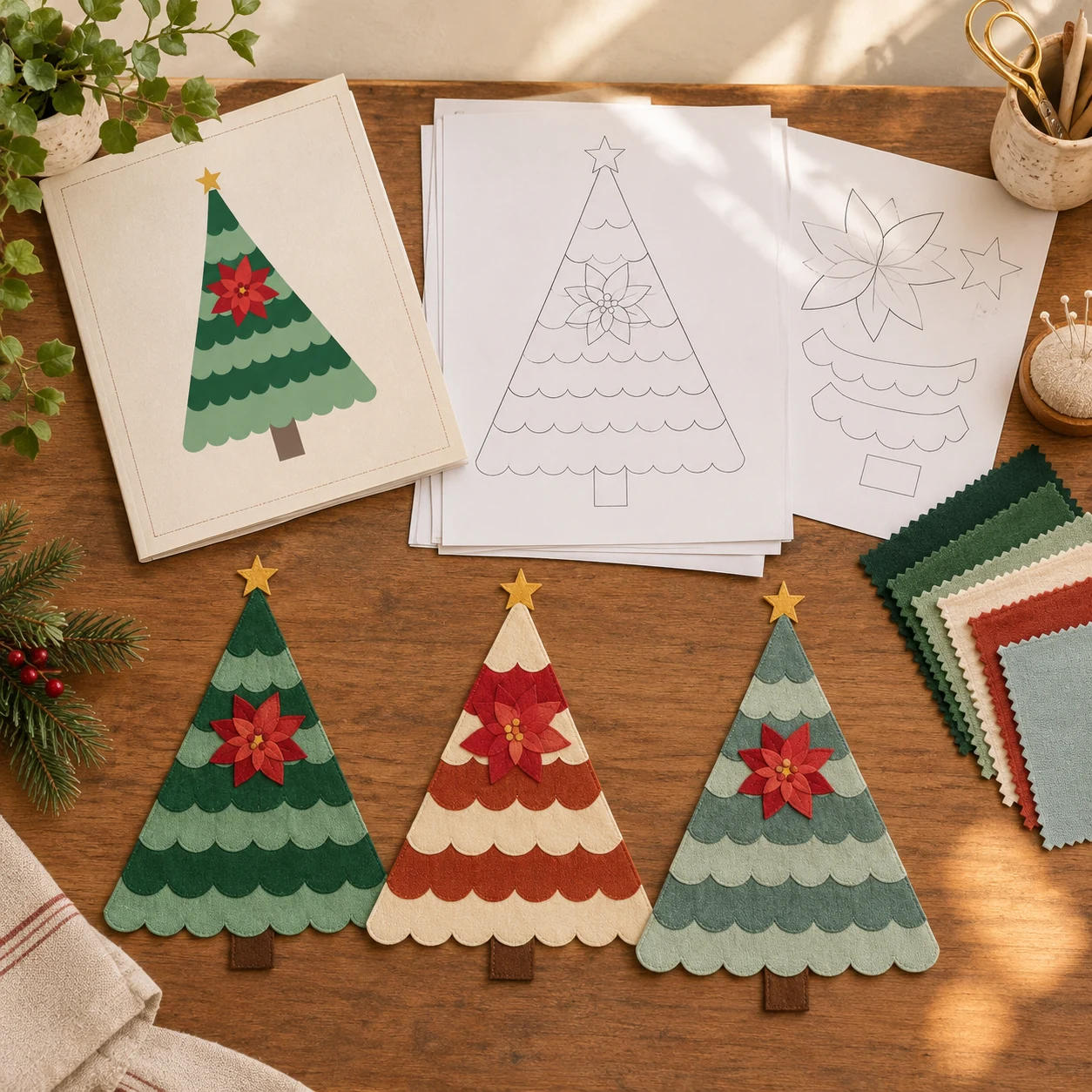
Because the tiers overlap, you do not match points, and the scallop stitching quilts the piece. The pattern includes:
- 12 pages of instructions and an assembly map.
- 15 pages of tiled templates for Letter or 16 for A4.
- A cutting chart, materials list and three colorways.
- Instructions for raw-edge, turned-edge and fusible applique.
- Binding and hanging details.
For details on the flower, see poinsettia applique quilt pattern.
Supplies for applique
- Sharp small scissors or a rotary cutter for curves.
- Fusible web, if you choose that method. About half a yard of lightweight, paper-backed web covers all pieces in this pattern.
- A fine needle and matching thread.
- A pressing cloth. Fusible web should not touch your iron.
- Freezer paper for turned-edge.
- Pins or clips.
Common mistakes with applique
- Cutting on the wrong line. The solid line includes a seam allowance; the dashed line is the finished edge. Pick based on your method.
- Forgetting to reverse shapes. Fusible shapes are traced face down, so mirror-image counts change.
- Stitching too tight. Dense satin stitching on a thin fabric can pucker. Test first.
- Overworking small pieces. Berries and centers are small. Do not fuss; fuse and stitch.
Where to go next
If you are choosing among projects, see Christmas quilt patterns by project type or wall hanging patterns compared.
This is a personal-use digital pattern. It is not for resale or sharing. Sewing materials are not included.