Crochet Pattern PDF Library: 10 Things to Check Before You Buy
Before you buy a crochet pattern PDF library, check ten things: sample pages, how the files are sorted, what the terms allow, whether a beginner guide is included, the real count of patterns, how delivery works, refunds, print and device use, duplicates and quality, and whether the seller makes promises you cannot verify. A large library can be good value, but it can also be a pile of files you never open. This checklist helps you tell the difference, and the last section shows how 1,947 Amigurumi Patterns answers each point.
1. Can you see sample pages?
Ask for or look for screenshots of real pattern pages, not just a cover. You want to see the layout, the photos, the notation and the level of detail. If every pattern in the preview is a cover image, you do not know what you are buying. Open samples from different folders, because quality may differ between designers.
2. How are the files organised?
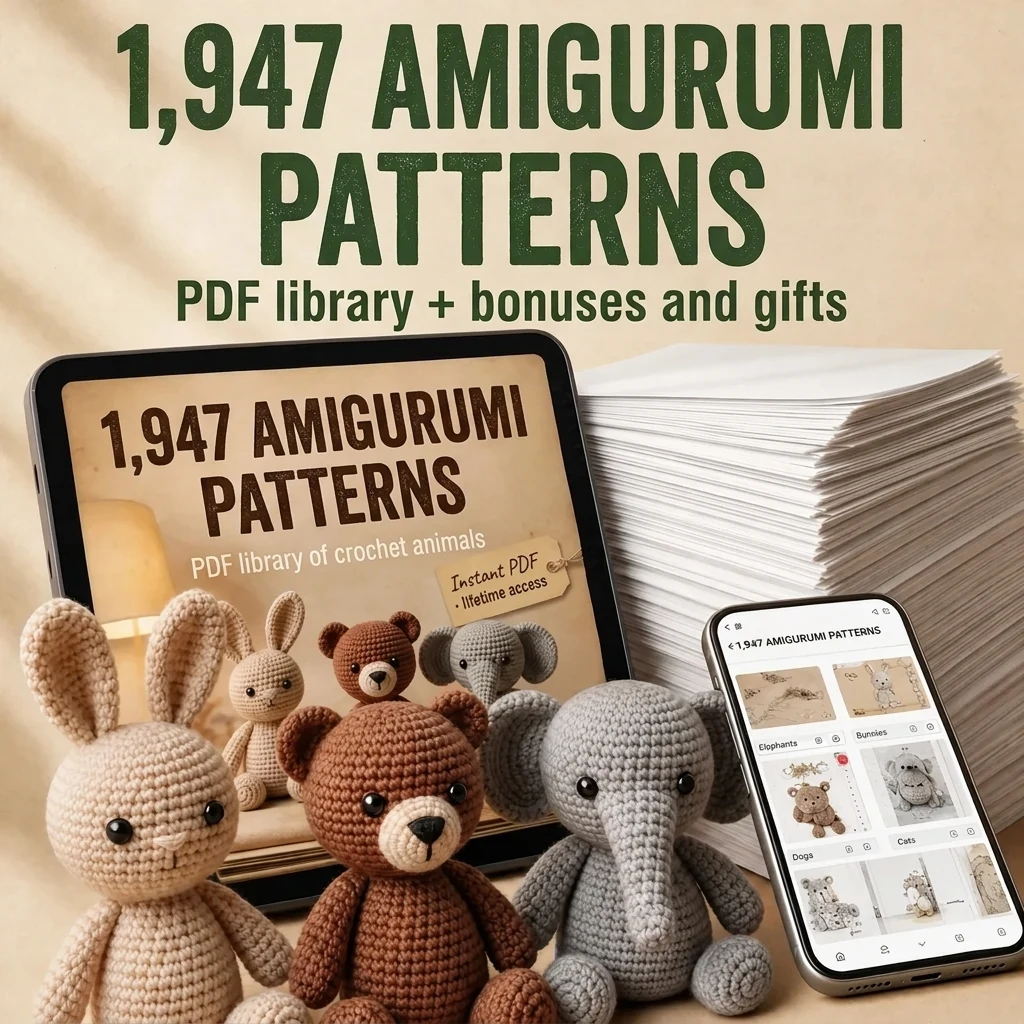
A thousand patterns in one folder is almost unusable. Look for folders by animal, season and type, and file names that tell you what is inside. You should be able to find "bunnies" or "Christmas" in two clicks.
3. Is the count real?
Pattern counts in titles are sometimes inflated by duplicates, multi-part files or reprints. A trustworthy seller breaks the count down by category. If a library claims thousands but only shows a handful of categories, ask how they were counted. As a rule, a breakdown that adds up is a good sign.
4. What do the terms allow?
Read the terms before you pay. Look for:
- Personal use: printing and using the patterns yourself.
- Selling finished items: many sellers allow you to sell the toys you make by hand, but not the pattern files.
- Characters: designs of characters that belong to somebody else are not yours to sell, even in a new colour.
- Sharing: you generally may not share, upload or resell the files.
If you plan to sell, read what the library allows and what it does not.
5. Is there help for beginners?
Hundreds of patterns do not teach you how to crochet a toy. Look for a handbook that covers the magic ring, counting, stuffing, closing and sewing, a glossary of abbreviations, and a plan for the first weekend. Without them, a library is a catalogue, not a course. The beginner guide shows what that plan looks like.
6. Which terms do the patterns use?
US and UK crochet terms use the same names for different stitches. Check that the patterns say which they use, and that a conversion chart is included. The US and UK terms list shows how the names shift.
7. How does delivery work?
You want a clear answer to these questions: do you get a download page or a link? Does it work on a phone and a computer? Can you come back to it later? Will you receive an email with the link? Instant access is common, but check that a download page stays available and that you can bookmark it.
8. What is the refund policy?
A seller confident in the product states a refund period in plain words. Look at the length, the process and any exceptions. Do not rely on a promise that is not written down.
9. Will it work on your devices?
PDFs open on any device, but large libraries are heavy. Check the total file size and whether you can download folders one at a time. Think about whether you will read on a screen or print.
10. Do the promises add up?
Be cautious of claims you cannot verify: invented review numbers, income guarantees, countdown pressure or "limited to the first buyers". A good seller describes what is in the product and lets you decide. For patterns, the useful questions are "what is in it?" and "what can I do with it?"
Quick checklist
| Check | What good looks like |
|---|---|
| Samples | Real pattern pages from several folders |
| Organisation | Folders by animal and season |
| Count | A category breakdown that adds up |
| Terms | Clear on printing, selling toys and sharing |
| Beginner help | A handbook, a glossary and a first-pattern plan |
| Notation | States US or UK terms and gives a conversion |
| Delivery | A bookmarkable access page |
| Refund | A stated period in writing |
| Devices | Works on phone, tablet and computer |
| Promises | No guarantees of income or fake scarcity |
How 1,947 Amigurumi Patterns measures up
Use the list above on this library, and check each answer for yourself.
- Organisation: the patterns sit in folders. The Animals folder holds 795, split into bunnies (222), forest and jungle (116), bears (83), cats (77), birds (58), sea animals (52), farm animals (46), dinosaurs and dragons (45), frogs, turtles and reptiles (37), bugs (28) and dogs (21). Other folders include Christmas (178), Valentine's Day (104), keychains and minis (140), clothing and accessories (111), home and decor (75), bags (68) and 51 magazines and books.
- Beginner help: the First Plush Handbook, the First Weekend Shortlist, a Crochet Stitch & Abbreviations Guide and the Yarn, Hook & Leftover Calculator are included, plus a Gift Animal Planner and the Kitchen Table Stall Kit.
- Terms: the Kitchen Table Stall Kit says you may sell the finished handmade toy you crocheted, not the pattern files, and not characters that belong to someone else.
- Delivery: you receive a personal access page that lists your files, and a link by email.
- Refund: a 365-day money-back guarantee applies.
- Limits: the patterns come from many designers, so style and detail vary. The collection is a fixed set of files.
Compare it with the alternatives. A pattern book is more consistent but smaller, a marketplace pattern is a single design with support, and a physical kit includes materials for one toy.
Go deeper
1,947 Amigurumi Patterns is a PDF library of crochet and amigurumi patterns sorted into folders, with beginner guides, a yarn and hook calculator, a gift planner and a selling guide, delivered through a personal access page with a 365-day money-back guarantee.