Etsy Amigurumi Patterns vs a Pattern Library: An Honest Comparison
Buy a single pattern from a marketplace such as Etsy when you want one particular design by a designer you like and can ask questions. Buy a pattern library when you want to browse hundreds of animals and seasons for a low cost per pattern. The two work well together, and the right choice depends on what you are making and how often. Here is how they compare.
Side by side
| Question | Single pattern from a marketplace | Pattern library |
|---|---|---|
| What you get | One design (sometimes a small set) | Hundreds or thousands of patterns |
| Cost per pattern | You pay for each design | Spread across the whole library, under one cent each |
| Choice | Exactly the design you searched for | Browse by animal and season |
| Designer support | Often: messages, corrections, test-crochet notes | Generally none for individual files |
| Quality | Varies by shop; reviews help | Varies by designer inside the library |
| Photos | Often step-by-step | Varies from pattern to pattern |
| Licensing | Set by each designer | One set of terms for the whole library |
| Selling finished toys | Per designer, usually in the listing | One set of rules, in the product |
| Newest trends | Yes, designers follow them fast | Fixed collection |
When a single pattern is the better buy
- You have seen one exact design and want it. A library may not have it.
- You want the designer's support, for example to ask what a step means.
- You want a pattern written for a specific yarn or size.
- You want to support an independent designer.
When you buy single patterns, check a few things before you pay. The listing should show original photos of the finished toy, state the level, the yarn weight and the finished size, and describe how the PDF is organised. Shop history on the marketplace helps you judge how long a designer has been selling. Avoid listings that use characters you recognise from films, shows or games; those belong to someone else and selling toys of them can cause trouble.
When a library is the better buy
- You make a lot of toys, so a low cost per pattern adds up.
- You like to browse. A folder of bunnies or Christmas ornaments is easier to scan than a search page.
- You want a teaching package with a handbook, a glossary and a plan.
- You want a fixed set of rules for what you can sell.
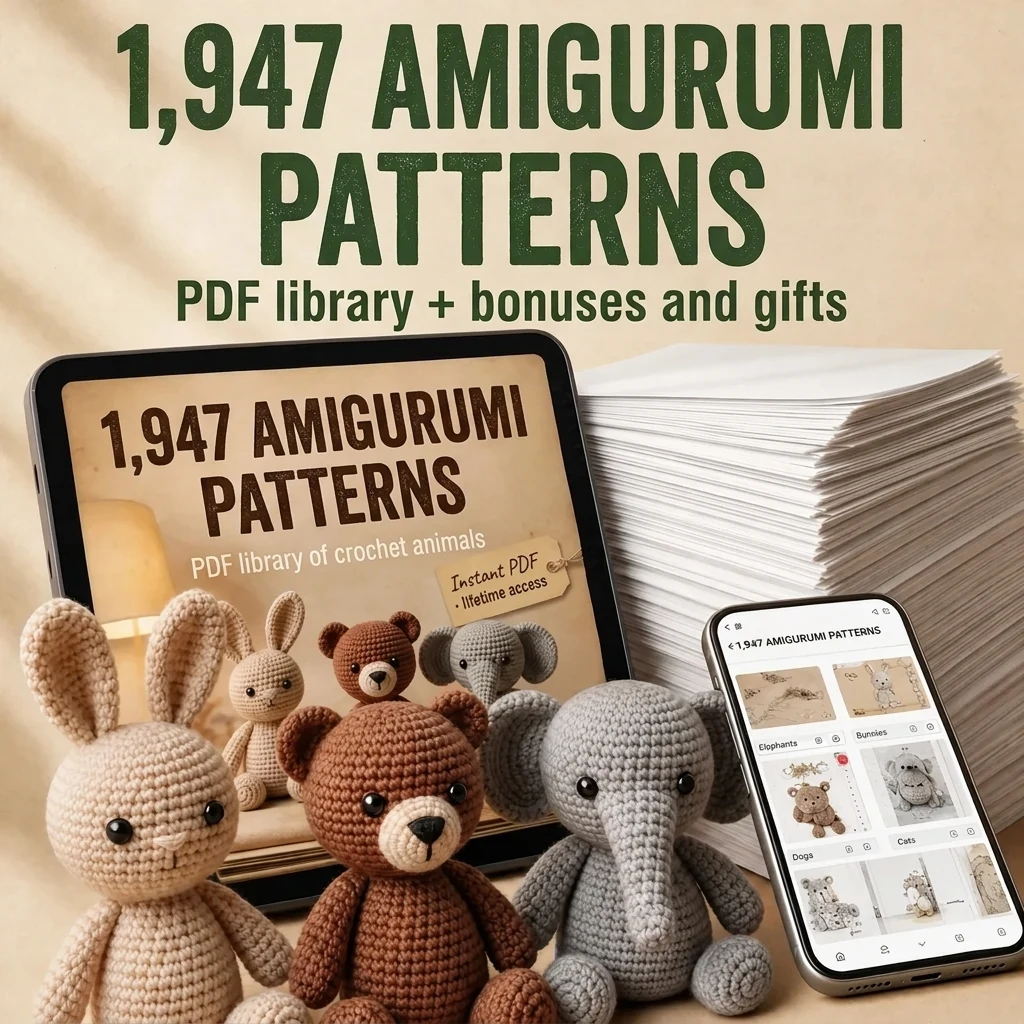
The library in 1,947 Amigurumi Patterns has 795 patterns in the Animals folder (bunnies 222, forest and jungle 116, bears 83, cats 77 and others), 178 for Christmas, 140 keychains and minis, 111 clothing and accessories, 104 for Valentine's Day, 75 for home and decor and 68 bags, along with bonus guides for beginners. See the animals sorted by group to get a feel for the structure.
What a library does not do
- It does not offer the newest designs. The collection is fixed.
- It does not come with a designer to ask. The patterns come from many authors.
- Quality is uneven. Some files have full photos; others are plain text. Look at samples first.
- It is not an exclusive. Others may have the same file.
- You cannot share or resell the files. The Kitchen Table Stall Kit says plainly that you may sell the finished toys you crochet, not the patterns, and that characters belonging to someone else are not yours to sell.
A simple way to combine both
- Use a library to find the shape you like and learn the basics.
- Buy one designer pattern when you want a special project or one specific look.
- Keep a project log: note yarn, hook, eye gap and grams left, so the second toy matches the first.
- Read the terms each time you plan to sell.
For a checklist on what to look at in any library, see what to check before buying a crochet pattern PDF library. If you also wonder about printed books, the book versus PDF library comparison goes through that choice, and if you are thinking about selling what you make, read what the library allows.
Go deeper
1,947 Amigurumi Patterns is a PDF library with folders for animals, seasons, keychains, babies and more, plus a First Plush Handbook, a First Weekend Shortlist, a Crochet Stitch & Abbreviations Guide and a Kitchen Table Stall Kit that states what you may and may not sell.