A5 Notebook Template Printable: Which Size Should You Bind?
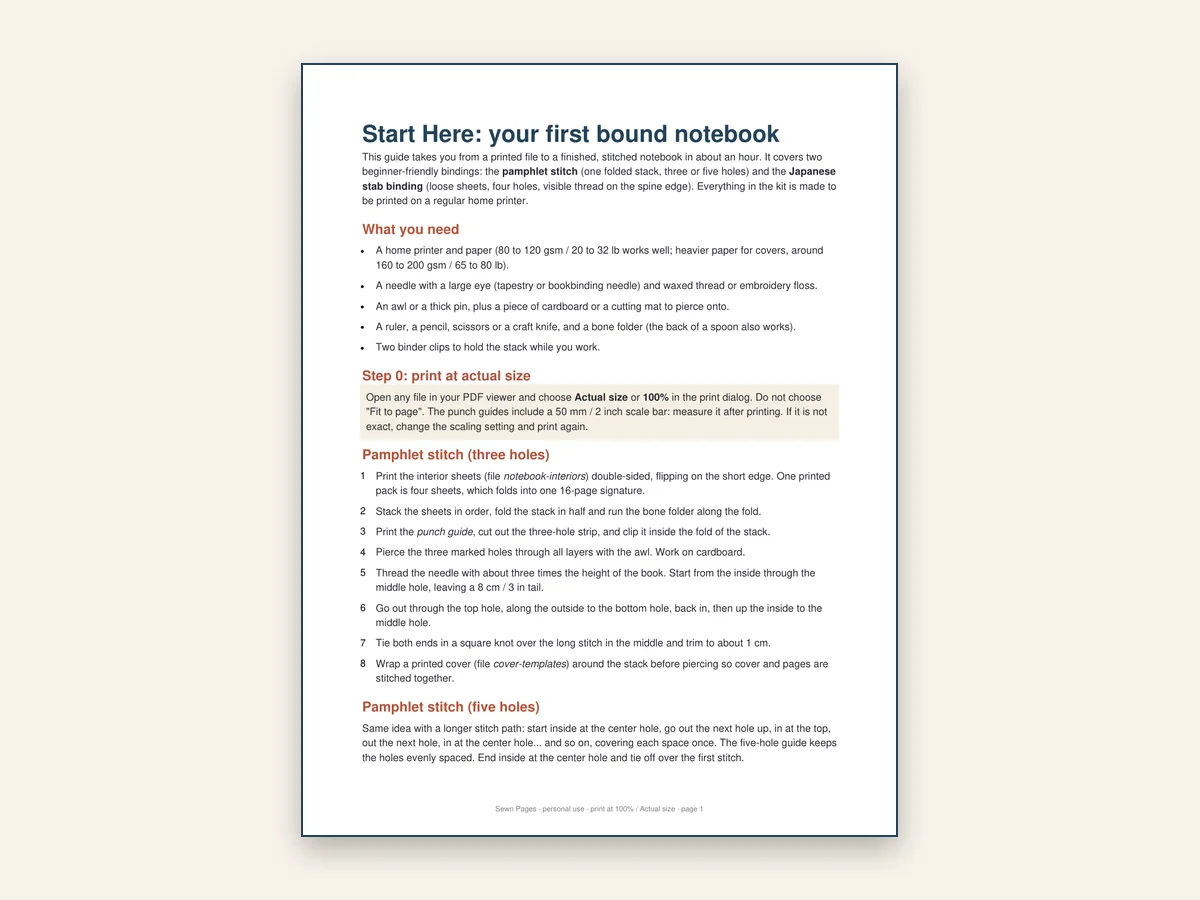
A5 is the best all-round notebook size, A6 is the best first project, and Half-Letter is the one to choose if you live by a planner. A good template set draws all three, so you can switch sizes without rebuilding anything.
Before you print a single page, choose the size. It decides how much paper you use, how long the book takes, what binding suits it and what you will use it for. Here is how the three compare, and how a printable template changes the work.
The three sizes in plain terms
A5 is half an A4 sheet, about 148 by 210 millimetres. It sits comfortably on a desk, takes a full page of writing and fits in most bags. It is the standard for journals and notebooks in much of the world.
A6 is half an A5, about 105 by 148 millimetres. It slips into a coat pocket. It is quick to bind, uses little paper and makes an excellent gift.
Half-Letter is half of a US Letter sheet, 5.5 by 8.5 inches. It is the usual planner and journal size in the United States, a touch shorter and wider than A5.
Which one for which job
| Use | Best size | Why |
|---|---|---|
| First practice book | A6 | Fast, cheap, forgiving |
| Daily journal | A5 | Room to write, still portable |
| Planner or agenda | Half-Letter | Fits US planner habits |
| Pocket notes | A6 | Goes anywhere |
| Sketchbook | A5 | More drawing room |
| Gift set | A6 and A5 | A matching pair looks generous |
If you can only make one size, make A5. If you can make two, add A6.
What changes between sizes
Everything on the page scales, but not all of it scales equally, which is why templates are worth having.
- Punch guides. The hole positions differ, and the number of holes matters. A6 looks right with three holes in a pamphlet; A5 and Half-Letter are steadier with five. The kit has guides for 3 and 5 holes in pamphlet stitch and 4 holes in Japanese stab binding, drawn for each size.
- Cover flats. Spine widths vary with thickness, and the cover size follows the page size. The kit includes nine flats, three sizes at three spine widths.
- Interiors. Lined, dot grid, squared and Cornell pages are laid out for duplex printing and folding, matched to the chosen size.
- Paper use. An A5 folded from A4 wastes nothing. A6 from A5 doubles up. Half-Letter from Letter does the same.
Paper size and book size
Your printer paper is A4 or US Letter, and your book is smaller. The logic is simple: a sheet folded in half gives a book half its size. Fold A4 and you get A5. Fold Letter and you get Half-Letter. Fold an A5 sheet and you get A6.
For that reason, the kit provides every file in both A4 and US Letter. You choose your paper size first, then the book size inside it, and print.
If you live in a region that uses one paper size but you want a book size from the other system, it is possible, but you may need to trim. Check the template notes in the Start Here guide.
Building an A5 notebook in an evening
- Choose binding. For a slim book, pamphlet stitch with 5 holes. For a thicker one, stab binding with 4 holes.
- Print the interiors. Pick lined or dot grid, double-sided, at actual size.
- Print the cover flat at the spine width closest to your stack, on card or heavy paper.
- Fold, clip, pierce. Use the A5 punch guide.
- Sew, tie, label.
Time: roughly the length of a film for the first, a good deal less for the second.
Why a template beats cutting your own
Cutting paper to size seems easy. But when you cut by hand, each sheet differs slightly, the edges look ragged and the cover never quite matches. Printing onto a sheet and folding gives you consistent sizes without cutting at all. For the cover, a printed flat tells you exactly where the folds go.
If your first notebook came out wonky, the cause is usually the missing guide, not your hands. The templates are that guide.
Tips for each size
A6: use three holes in a pamphlet stitch, a narrow spine and a decorative paper with a small pattern. Keep the stack to three or four sheets.
A5: use five holes for pamphlet, or four-hole stab for thicker stacks. Choose a cover paper with some weight.
Half-Letter: use five holes, and consider squared or Cornell pages for planning. Mind the margins if you add a ruled column.
Where to go from here
If you are not sure which binding to start with, read the pamphlet stitch template guide. For covers that fit, see printable notebook covers, and for pages, printable notebook interior pages.
To see the whole set, read about the bookbinding starter kit. Whichever size you choose, print the guide, pierce where it says and let the book come out the way you pictured it.
A quick decision guide
If you are still stuck, answer three questions.
Where will the notebook live? In a pocket or small bag, choose A6. On a desk or in a rucksack, choose A5. In a planner stack with other US-format papers, choose Half-Letter.
How much will you write per page? Lots of text or drawings need the room of A5 or Half-Letter. Quick lists and sketches are fine on A6.
How patient are you tonight? A6 books are finished in far less time. They are the best way to confirm that your printer, thread and awl work together before committing good paper to a larger book.
Sizing mistakes to avoid
- Mixing sizes between files. An A5 cover with Half-Letter interiors will not fit. Keep every file for one book in the same size.
- Forgetting the spine. Even a slim stack has thickness. Use the spine guide, not the page size, to choose the cover flat.
- Printing from a different paper size than you planned. If your printer defaults to Letter and you chose A4 files, the scale prompts will mislead you. Pick the file set that matches the paper in the tray.
- Binding too many sheets for an A6. A small book with a thick stack bulges and fights the thread. Keep small books slim.
Sizes for a small product line
If you plan to sell, a clear A6 and A5 pair is easy to explain and photograph. Add Half-Letter only if your buyers use that size. The same decorative paper can wrap all three, which keeps your line looking like one collection and keeps your printing simple.