How to Sell Handmade Notebooks Without Underpricing Them
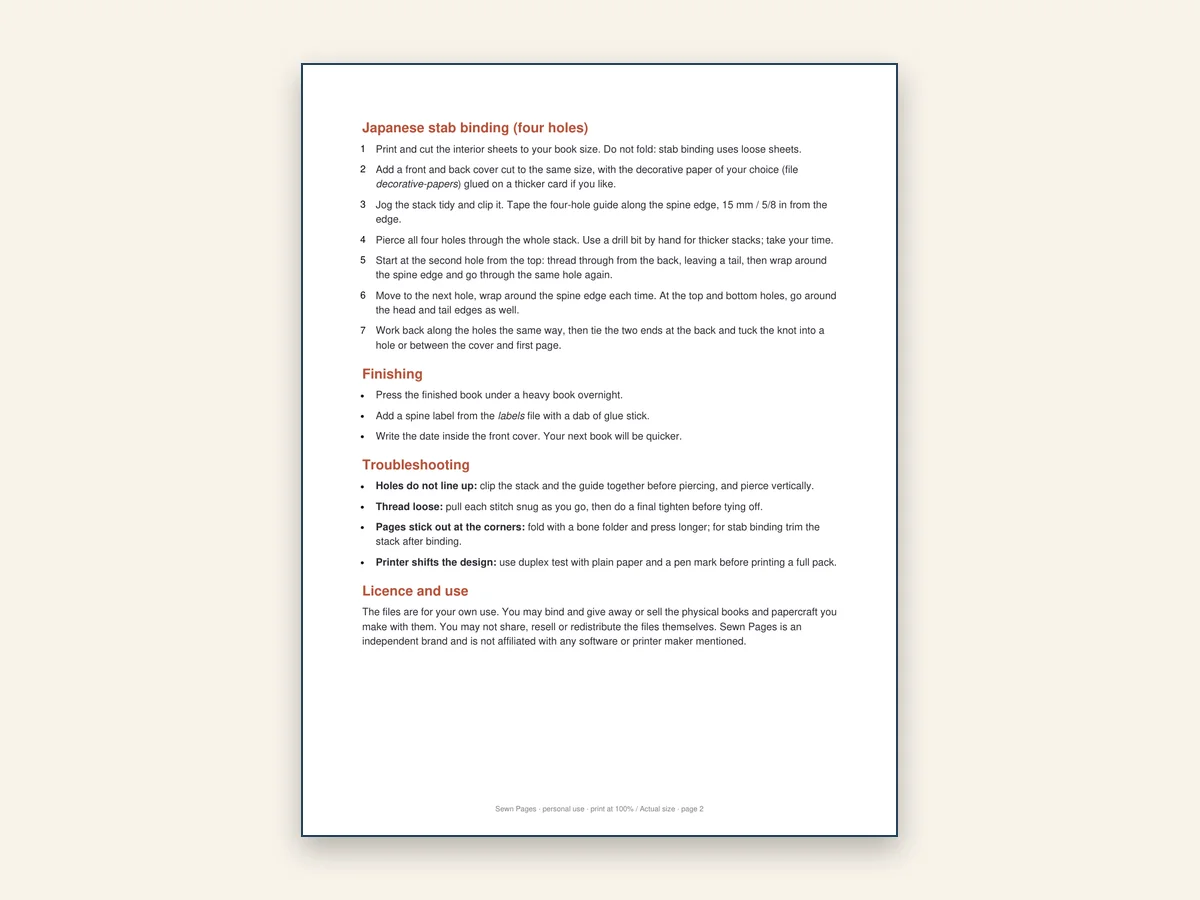
The way to sell handmade notebooks profitably is to make them repeatable: one size, a handful of patterns, a fixed process and a price that includes your time. A binding that takes an hour with no guide takes twenty minutes with one, and that difference is the margin.
Plenty of people bind a notebook as a hobby, give it to a friend and hear "you should sell these". Few do the sum that turns a lovely object into a few reliable sales. This guide walks through the sum, the batching and the finishing that make handmade books worth the effort.
Start with a line, not a single book
Customers rarely buy one oddly sized notebook. They buy a product that looks like it belongs to a shop: a clear size, a clear look, and a few options. So decide your line before you make anything for sale.
A sensible first line:
- Two sizes. A6 for pocket, A5 for desk. Half-Letter if you sell in the United States and want a planner size.
- One or two bindings. Pamphlet stitch for slim books, Japanese stab for thicker ones.
- Three or four patterns. Pick from your decorative papers and stick with them, so photos and tables look like one collection.
- A few interior styles. Lined, dot grid, squared, maybe Cornell.
Constraints make you faster. When every cover is a template and every punch guide is printed, there is nothing to measure.
Do the cost sum honestly
Handmade sellers underprice because they forget half the costs. List these for a typical A5 notebook:
- Paper: interior sheets and cover stock.
- Thread, glue and consumables.
- Printing: ink and wear on the printer.
- Finishing: label, tag, plate and wrap.
- Packaging: a sleeve, a bag or a box.
- Platform fees if you sell online, and table costs if you sell at a fair.
- Your time. Count the minutes from print to wrapped.
For time, choose a rate you could live with and multiply by the minutes. If a notebook takes thirty minutes at a rate you would not accept, the notebook is not worth selling at that price, or you need to speed up.
Then compare your total with what similar notebooks sell for. If you are far below, raise your price. If you are far above, check whether your look, materials and photos justify it, or find savings. Do not copy the cheapest listing; they may be selling mass-produced notebooks and you are not.
Batch to save time
Making ten notebooks one at a time is slower than making ten in stages.
- Print all interiors for the batch.
- Print and score all covers.
- Fold all stacks.
- Pierce all stacks.
- Sew all.
- Label and wrap all.
Each step repeats the same hand motion, so you speed up. Template files help because every cover and punch guide for a given size is identical. One print setup serves the whole run.
Make it look like a product
A notebook photo that sells has three qualities: a clean background, soft light and a close look at the cover and spine.
- Shoot by a window in daylight, on plain paper or a wooden table.
- Take one shot of the cover, one of the spine, one open showing the pages, and one with the tag or plate.
- Keep the backgrounds the same across the line.
Add a spine label, a book plate inside and a gift tag. The label sheet in the kit has twelve spine labels, twelve gift tags and twenty-four book plates on three pages, so small touches cost almost nothing.
Packaging and care
A simple sleeve of paper, a ribbon and a tag is enough. For shipping, flat card and a stiff envelope protect corners. If you include a care card, keep it short: store dry, avoid direct sun, use pencil or pen suited to the paper.
Where to sell
- Craft fairs and markets. Good for testing. People pick a notebook up, feel the cover and decide in seconds.
- Online marketplaces. Good for reach. Your tags and titles matter; see how buyers search for items like yours.
- Gift shops and cafes. A small consignment batch can work if your look is consistent.
- Your own contacts. Teachers, clubs, and small businesses often want branded or custom notebooks for gifts.
A starter plan
Make twelve notebooks: six A6 and six A5, split across three patterns. Price them using your cost sum. Photograph each pattern once. Take them to one market or list them online, and note which sells and which does not. Make the next batch of the winners.
Keep it honest
Do not promise results you cannot guarantee, and do not describe your notebooks in ways you cannot back up. Say what they are: handbound, with a pamphlet or stab stitch, on a particular paper, in a particular size. Details like that sell better than adjectives.
Also remember the licence: you may sell the physical books you bind with the kit, but you may not share or resell the files. Check local rules about selling goods, and the terms of any platform.
Next steps
If you have not yet bound a book, begin with the bookbinding starter kit guide. To build a consistent look, read about decorative papers for covers. For gift-ready presentation, the handmade notebook gift guide has packaging ideas.
A small, steady line of notebooks beats an occasional showpiece. Choose your sizes, fix your process, and let the templates do the measuring.
Keeping a simple record
Even a very small business benefits from a tiny log. Note the date, the size and pattern of each notebook, the materials cost, the time it took and the price it sold at. After two or three markets you will see which patterns repeat and which sit in the box, and whether your time estimate was honest. A notebook that sells but takes an hour to make may be worth dropping; a quick one that sells steadily is worth doubling.
Handling custom requests
Customers will ask for a particular colour or a name inside the cover. Say yes to small, quick changes, such as a book plate with a name or a different thread colour, and charge a little for them. Say no to anything that breaks your process, like an odd size that needs a new layout. Your line stays profitable when your templates stay fixed.
Starting small is the point
You do not need a studio. A table, a printer, a cutting mat and a box of supplies is enough. The goal of the first batch is to learn what people pick up, what they ask about and what they walk past. Treat it as research that also pays for your paper.